
Apple launches Health AI Usage Study with OpenEvidence
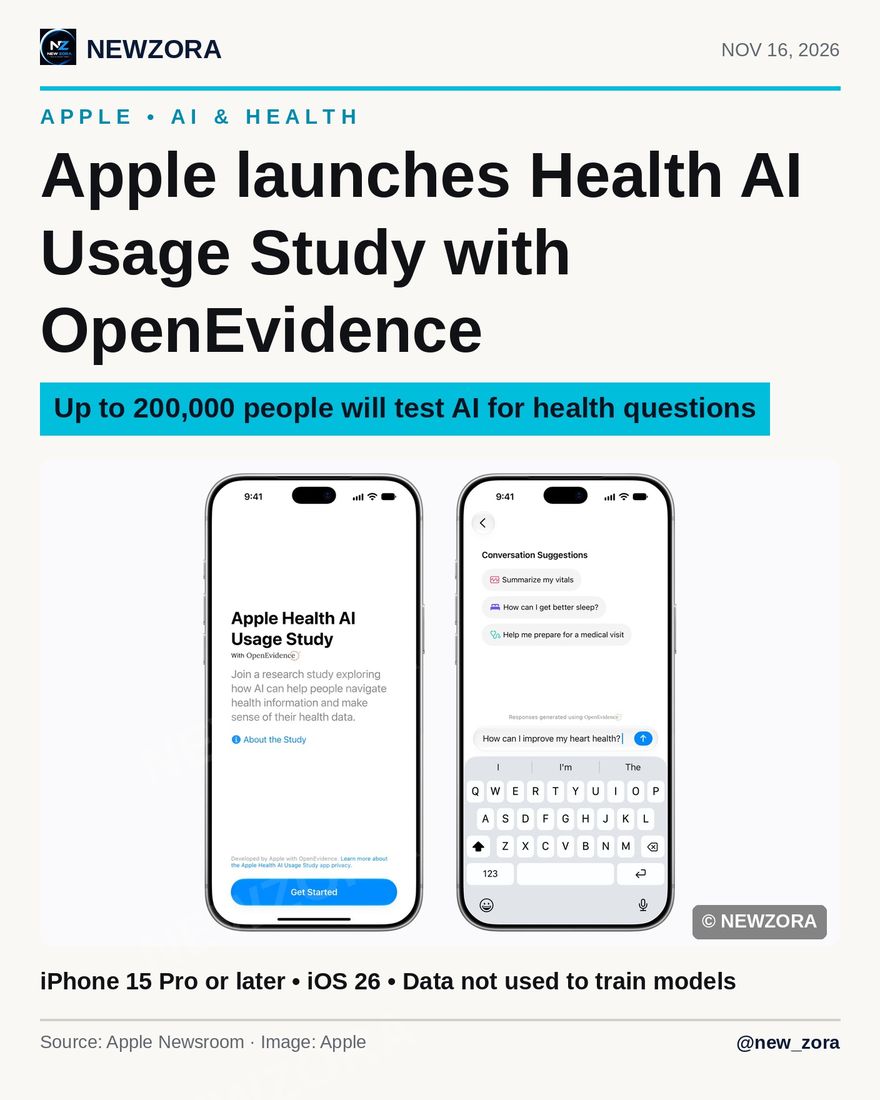
Apple announced on 15 November 2026 a new research programme, the Health AI Usage Study, conducted in collaboration with OpenEvidence. The programme is a virtual study with a dedicated application, and it is designed to examine how people use artificial intelligence to understand their health. The announcement places the study at the intersection of two developments that have advanced largely in parallel: the rapid public adoption of artificial intelligence tools for health questions, and the clinical profession's demand that such tools be tested against medical evidence before they are trusted.
What the study is
The Health AI Usage Study is a virtual study, meaning that participation takes place through a dedicated application rather than through in-person clinic visits. Apple developed the study in collaboration with OpenEvidence, a clinical artificial intelligence platform that is widely used by healthcare professionals. OpenEvidence provides the underlying technology for the study application. Its responses are grounded in medical information drawn from sources that include the New England Journal of Medicine, JAMA, and Nature, and each response carries linked citations to peer-reviewed clinical literature.
Eligibility is limited. The study is available in the United States only, and enrolment is capped at 200,000 eligible participants. Participants must be aged 21 or older. Participation also requires an iPhone 15 Pro or later, running iOS 26 or later, with Apple Intelligence enabled. The device requirement is specific: the base iPhone 15 and iPhone 15 Plus do not meet the eligibility criteria.
What participants will do
Participants will use the study application to ask everyday health questions and to explore complex medical information presented in approachable language. Each response will include linked citations, allowing participants to trace the information back to its clinical source. The study therefore examines not only the answers an artificial intelligence system provides, but also whether participants can follow the evidence behind those answers.
Participation includes an optional component. Participants may choose to share selected data from Apple Health, including resting heart rate, activity, sleep, and laboratory results, with the study. The purpose of this option is to test whether personal health data improves the relevance and the comprehensibility of the responses a participant receives. Sharing is optional, and the study design treats the comparison between responses with and without personal data as a central research question.
What the study is designed to measure
The stated purpose of the study is to examine trust, response quality, comprehension, and the everyday health actions that follow from the use of artificial intelligence. The programme also seeks to determine whether the application helps participants prepare for clinical visits, for example by giving them a clearer understanding of the questions they wish to raise with a clinician.
Sumbul Desai, M.D., Apple's vice president of Health and Fitness, framed the programme as an exercise in evidence before deployment, stating that "responsible innovation starts with scientific rigor and clinical grounding". Robert M. Wachter, M.D., of the University of California, San Francisco, described the gap the study is intended to address: "Patients and clinicians are both turning to AI, but the tools they use are being built and tested in separate worlds". The two statements together describe the study's premise. Patients and clinicians are adopting artificial intelligence, but they are doing so with different tools, tested under different conditions, and the study is an attempt to bring those two uses into a single, measured framework.
Data use and safety
Apple has stated that study data will not be used to train AI models. That commitment is stated explicitly in the announcement and is central to the study's design, because it separates the research function of the programme from the development of commercial products.
The application also includes safety guardrails. The guardrails are designed to detect concerning questions and to suggest that the participant follow up with a healthcare provider. The application is not intended to diagnose or treat any condition, and it is not a replacement for medical advice. That limitation is stated in the announcement and is consistent with the study's status as a research programme rather than a clinical service.
Why it matters
The Health AI Usage Study matters for three reasons. First, it addresses a question that has so far been answered largely by anecdote: whether people can understand, trust, and act appropriately on health information produced by an artificial intelligence system. By recruiting up to 200,000 participants, the study is designed to produce evidence at a scale that smaller evaluations cannot provide.
Second, the study tests whether personal health data changes the quality of artificial intelligence responses. If access to resting heart rate, activity, sleep, and laboratory results improves relevance and comprehension, that finding would support a model in which health artificial intelligence is personalised. If it does not, that result would be equally informative, because it would indicate that personalisation alone does not resolve the problem of quality.
Third, the study places clinical grounding at the centre of the evaluation. By building the application on a platform whose answers are grounded in peer-reviewed literature from journals including the New England Journal of Medicine, JAMA, and Nature, and by attaching linked citations to each response, the study tests a specific proposition: that traceable evidence is a precondition for trust in health artificial intelligence.
What comes next
Enrolment is limited to eligible participants in the United States, and the cap of 200,000 participants defines the scale of the programme. The announcement does not state when results will be published, and it does not describe any product that would follow from the study. The study is presented as research, and its findings will determine whether the approach it tests is sound. For now, the programme's significance lies in its design: a large, virtual, citation-grounded study of how people actually use artificial intelligence for health, conducted with the explicit commitment that the data it collects will not be used to train AI models.
Sources
- Apple Newsroom