Google launches Gemini 4 Neon
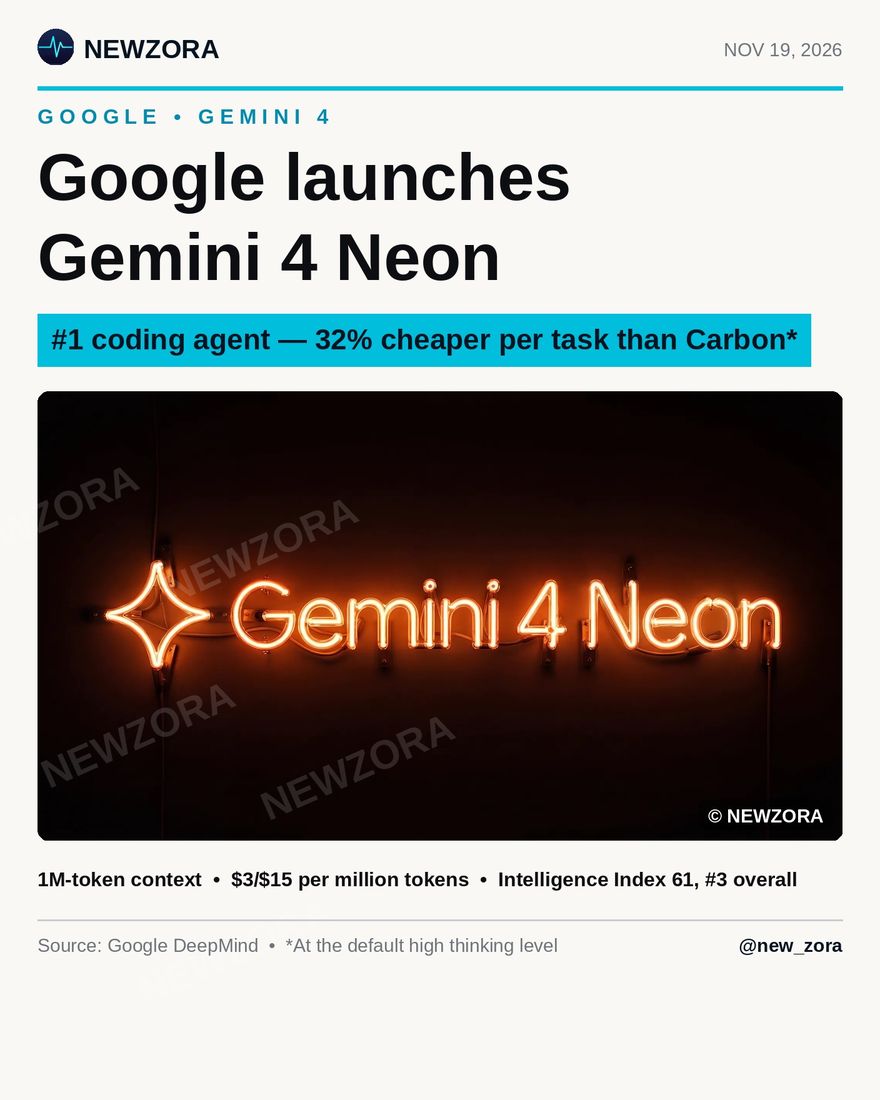
Google DeepMind introduced Gemini 4 Neon on 18 November 2026, the fourth model in the Gemini 4 family to arrive in a period of seven weeks. Announced by Koray Kavukcuoglu, Senior Vice President at Google DeepMind and Google Chief AI Architect, Neon is positioned as a middle ground within the family: frontier-level intelligence combined with fast end-to-end completion of complex tasks. The model is aimed at demanding coding, knowledge work and scientific work, and it is available from 18 November 2026 through the Gemini API, the Gemini app for paid subscribers, and selected developer tools.
What Happened
Gemini 4 Neon follows three earlier releases in the same family. Argon and Carbon became broadly available on 10 November 2026, and Hydrogen launched on 12 November 2026. According to Artificial Analysis, Neon is the fourth Gemini 4 model in seven weeks, a release cadence that Google has sustained through the autumn of 2026. The announcement was made on the Google DeepMind blog on 18 November 2026, with secondary coverage from TalkAndroid and FoneArena confirming the date, the positioning and the rollout details.
Google describes the family in terms of distinct roles. Carbon is intended for the hardest, long-horizon projects. Hydrogen is built for fast everyday execution. Neon occupies the space between them: it is designed to bring frontier-level intelligence to tasks that require sustained reasoning, while completing those tasks quickly. The three models are therefore presented as complementary rather than successive replacements, and no official source states that Neon retires or replaces Argon.
Key Numbers
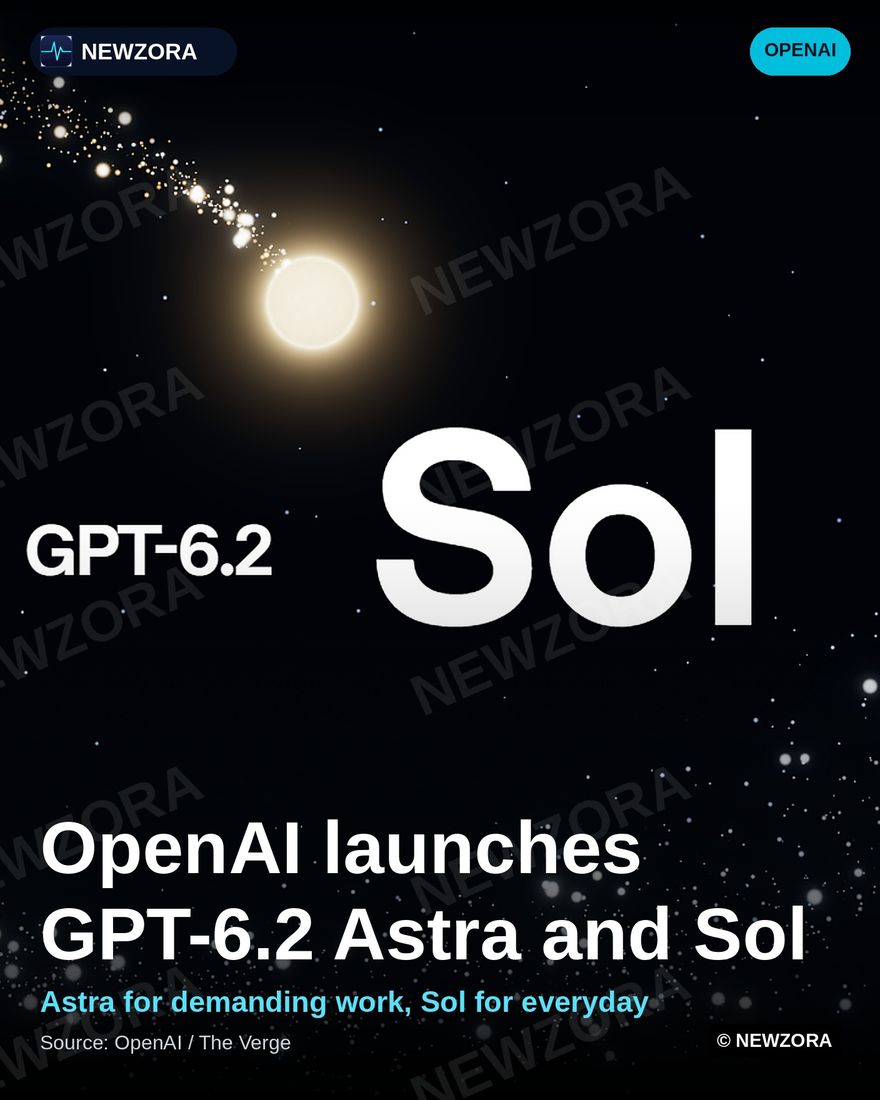
Neon scores 61 on the Artificial Analysis Intelligence Index at the xhigh thinking level, placing it third overall. It ranks behind GPT-6.2 Astra, which scores 62, and Claude Fable 5.2, which scores 65. The same measurement places Neon one point ahead of Gemini 4 Carbon, which scores 60. The Intelligence Index and the Coding Agent Index are evaluations conducted by Artificial Analysis; the remaining benchmark figures reported below are Google's own reporting of its model evaluations.
On the Artificial Analysis Coding Agent Index, Neon ranks first overall with a score of 58.6. Google also reports 65.2 percent on Terminal-Bench 4.1 and 46.2 percent on FrontierCode 2.0 at the default high thinking level. Other Google-reported results include second place on the Vals Index at 70.9 percent, second place on the Agent Arena Index at 1336, first place on the Zapier AutomationBench at 56.3 percent, and first place on Vending-Bench 2 with 16,843 dollars. Further Google-reported figures are 70.5 percent on Terminal-Bench Science, 84.0 percent on RiemannBench and 71.3 percent on HLE-Diamond.
The model offers a context window of one million tokens. According to Google, this allows Neon to synthesise spreadsheets, PDF documents, charts, audio and video into structured deliverables. Four configurable thinking levels are available: low, medium, high and xhigh. The xhigh level produces the highest intelligence score of 61 reported above.
Pricing through the Gemini API is 3 dollars per million input tokens, 0.15 dollars per million cached input tokens, and 15 dollars per million output tokens. The cached-input price represents a 95 percent discount relative to the standard input price. Google states that, at its default high thinking level, Neon costs 32 percent less per task than Carbon. That figure applies specifically at the default high level and should not be quoted without the qualifier. Artificial Analysis, measuring independently at the xhigh level, reports a different figure of approximately 17 percent lower cost per task, at 6.44 dollars against 7.76 dollars for Carbon, with approximately 40 percent less time per task. The two figures describe different measurement conditions and must not be conflated.
For context, Carbon's introductory API pricing is 2 dollars per million input tokens and 10 dollars per million output tokens through 30 November 2026, rising to 4 dollars and 20 dollars respectively from 1 December 2026. Carbon is therefore currently cheaper per token than Neon until 30 November, although per-token price and per-task cost are distinct measures.
Background
The Gemini 4 family has been introduced in rapid succession. Carbon and Argon arrived on 10 November 2026, followed by Hydrogen on 12 November and Neon on 18 November. Each release has been accompanied by benchmark reporting from Google and independent evaluation from Artificial Analysis, and each has been positioned for a different segment of work. The pattern indicates a strategy of segmenting the model family by task profile rather than issuing a single general-purpose successor.
Neon continues that approach. Its stated purpose is to handle work that is too demanding for a fast everyday model but does not require the longest-horizon reasoning of Carbon. Coding is the clearest example: Neon leads the Coding Agent Index, and its Terminal-Bench and FrontierCode results are reported at the default high thinking level, the level at which Google reports its per-task cost advantage over Carbon.
Availability
Rollout began on 18 November 2026. Neon is available through the Gemini API in Google AI Studio on the paid tier, and in Android Studio. It is available in Gemini for business, through the API and the model dropdown. It is available in Google Antigravity for paid Google AI Pro and Ultra subscribers, and in the Gemini app for Pro and Ultra subscribers.
Google has not stated that Neon is available to free Gemini users, and it has not announced availability in AI Mode in Search. The announcement makes no mention of Vertex AI. Availability beyond the channels listed above has not been confirmed, and no launch date for additional channels has been given.
A cybersecurity variant, Gemini 4 Neon for cyber, is rolling out to eligible members of the Fairwind Program over the coming days, according to Google. No further release date for that variant has been stated.
Why It Matters
Neon matters because it addresses the middle of the market that the existing family did not cover. Carbon serves the most demanding, long-horizon work, and Hydrogen serves fast everyday execution. A model that combines near-frontier intelligence with faster task completion is relevant to professional users whose work is complex but time-sensitive, particularly in software development, where Neon leads the Coding Agent Index, and in knowledge work and science, where long documents and multiple data formats must be synthesised into structured output.
The pricing structure is also significant. The per-task cost advantage over Carbon at the default high thinking level, combined with the 95 percent discount on cached input tokens, makes Neon a candidate for workflows that reuse large contexts, such as extended coding sessions or repeated analysis of the same document set. The distinction between per-token price and per-task cost remains important: Carbon's introductory per-token pricing is lower until 30 November 2026, so the cost comparison depends on the workload and the thinking level selected.
The release also consolidates Google's position in independent evaluation. A third-place ranking on the Intelligence Index, behind two rival models, and a first-place ranking on the Coding Agent Index place Neon among the leading models available in November 2026. The narrow margin over Carbon, one point on the Intelligence Index, indicates that the family's models are closely matched on general intelligence, while their differentiation lies in speed, cost and task profile.
What Is Next
The immediate question is how Neon performs in sustained professional use beyond benchmark conditions. Benchmark results, whether reported by Google or measured by Artificial Analysis, describe standardised tasks. Their relevance to real coding, research and knowledge-work workflows will become clearer as developers and paid subscribers use the model in the Gemini API, Android Studio, Antigravity and the Gemini app.
Further developments to observe include the rollout of Gemini 4 Neon for cyber to Fairwind Program members, any expansion of availability beyond the channels announced on 18 November, and the pricing change for Carbon on 1 December 2026, which will alter the per-token comparison between the two models. Google has not announced a successor or an additional Gemini 4 model.
Sources
- Google DeepMind official blog, "Introducing Gemini 4 Neon", 18 November 2026
- Artificial Analysis
- TalkAndroid
- FoneArena