
NVIDIA's first quarter without Huang: $115.8B revenue, up 103%
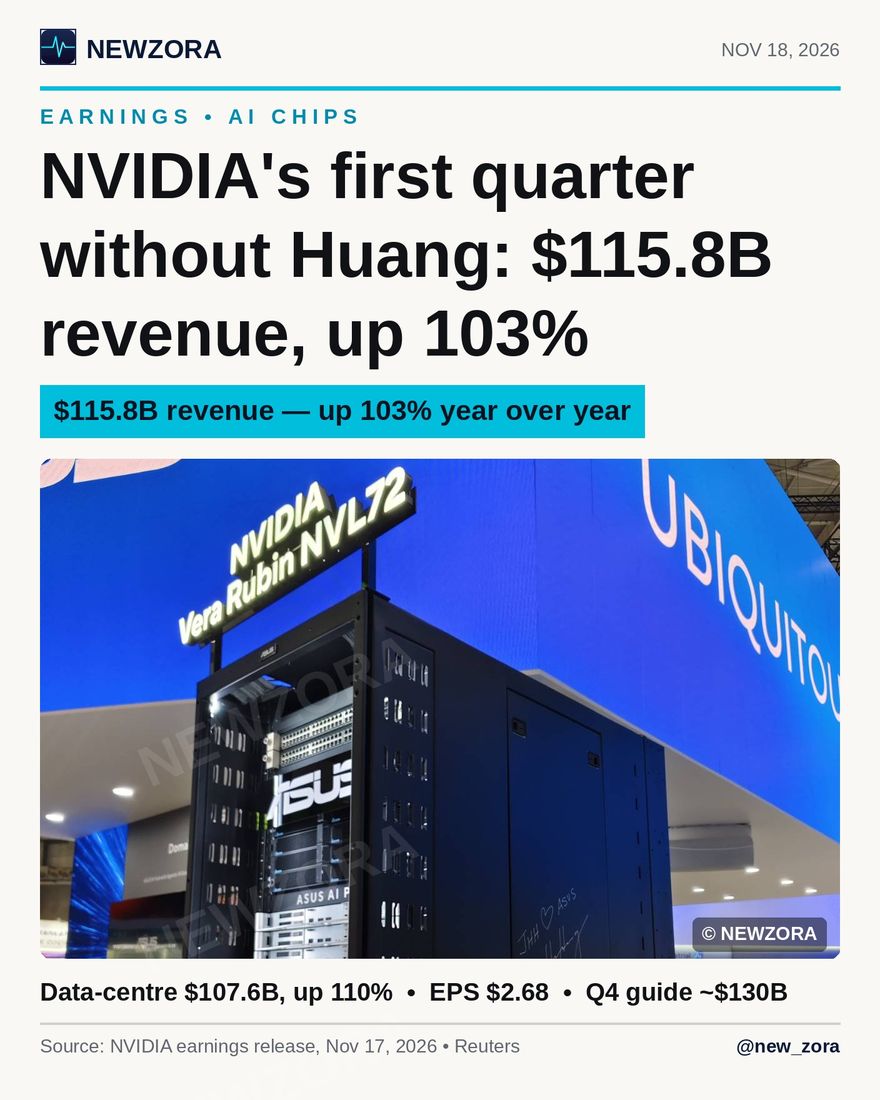
NVIDIA reported revenue of $115.8 billion for the third quarter of fiscal 2027, an increase of 103 percent from the same period a year earlier, in the company's first earnings report since co-founder Jensen Huang resigned as chief executive officer. The results, released on November 17, 2026 after the close of market trading, exceeded the expectations of analysts, and the company raised its outlook for fiscal 2028 revenue growth. The quarter ended October 25, 2026.
What happened
The earnings release marked a transition in NVIDIA's leadership. Huang's resignation as chief executive was announced on November 12, 2026. Interim chief executive Colette Kress led the earnings call, and board chair Harvey Jones said the board "does not intend to reinstate Jensen as CEO". Shares rose in after-hours trading following the release, according to reports of the market reaction.
The quarter was the first in which NVIDIA reported results without Huang in the chief executive role. The company presented the results as evidence that demand for its data-centre products continued to expand at a pace that outstripped the supply available to customers.
The key numbers
Revenue for the quarter was $115.8 billion, up 103 percent year over year. Data-centre revenue was $107.6 billion, up 110 percent year over year, accounting for the overwhelming majority of total revenue. Net income was $65.3 billion, up 105 percent year over year. Non-GAAP earnings per share were $2.68.
The results exceeded the consensus expectations of analysts. Consensus estimates ahead of the release were about $109 billion in revenue and about $2.47 in non-GAAP earnings per share. On both measures, NVIDIA reported figures above those estimates.
For the fourth quarter of fiscal 2027, NVIDIA guided revenue to about $130 billion, plus or minus 3 percent. The guidance assumes zero data-centre compute revenue from China. The fourth quarter has an extra week relative to a standard thirteen-week quarter. The company guided gross margin for the quarter to 71 to 72 percent. For fiscal 2028, NVIDIA raised its revenue growth outlook to about 75 percent, from about 70 percent previously.
Background and context
The scale of the reported quarter reflects the position NVIDIA holds in the market for the computing hardware used to train and run artificial intelligence systems. Data-centre revenue of $107.6 billion in a single quarter represents a level of demand that, a few years ago, would have exceeded the company's annual revenue. The 110 percent year-over-year increase in that segment indicates that spending by cloud providers and other large customers on AI infrastructure continued to accelerate rather than plateau.
The company also reported that its Vera Rubin NVL72 systems have begun shipping, and described the Vera Rubin launch as "the fastest product ramp in the company's history". The Vera Rubin platform is the successor to NVIDIA's Blackwell generation of AI systems, and its ramp is central to the company's revenue outlook for the coming quarters.
The leadership transition adds a further dimension to the quarter. Huang co-founded NVIDIA and led the company for more than three decades, during which it moved from graphics processors for personal computers to the dominant supplier of the accelerators that power modern AI. The board's decision to appoint Kress, previously the company's chief financial officer, as interim chief executive, and the chair's statement that the board does not intend to reinstate Huang, indicate that the transition is intended to be permanent, even though the board has not announced a permanent successor.
Why it matters
The results matter for three reasons. First, they provide a direct measure of the current state of AI infrastructure spending. Revenue growth of 103 percent at a scale of more than $100 billion in a quarter is not consistent with a market that is slowing. For investors, customers and competitors, the figures indicate that demand for AI computing capacity remains strong and that NVIDIA continues to capture the largest share of that spending.
Second, the guidance matters. A fourth-quarter revenue guide of about $130 billion, with an explicit assumption of no data-centre compute revenue from China, sets a high bar for the company's next report and signals management's confidence in the pipeline of orders for its new products. The raised fiscal 2028 revenue growth outlook, to about 75 percent from about 70 percent, extends that confidence into the following year. At the same time, the China assumption in the guidance is a reminder that export restrictions continue to shape the company's addressable market.
Third, the leadership transition matters. The first earnings report under an interim chief executive tests whether the company's execution continues without its long-standing leader. The strength of the reported quarter, and the raised outlook, suggest that the transition has not, at least in the short term, disrupted the company's commercial momentum. The question of a permanent chief executive remains open, and the market will continue to watch for the board's decision.
What is next
Attention now turns to the fourth quarter, which includes an extra week and carries the guided revenue of about $130 billion. The ramp of Vera Rubin NVL72 systems will be a central indicator of whether the company can convert its order book into delivered product at the pace implied by the guidance. The gross-margin guide of 71 to 72 percent for the quarter will also be watched, as it reflects the cost of the new product ramp.
The board's search for a permanent chief executive is a second matter to watch. Until a permanent appointment is announced, Kress continues in the interim role. Any further statement from the board on the succession process will be significant for the company's governance.
The broader question is whether the pace of AI infrastructure spending can be sustained. NVIDIA's results indicate that it was sustained through the third quarter of fiscal 2027. Whether the same holds through the fourth quarter and into fiscal 2028 will depend on the spending plans of its largest customers and on the company's ability to deliver its new systems at scale.
Sources
- NVIDIA's November 17, 2026 earnings release
- Reuters, November 18, 2026
- CNA
- ChosunBiz