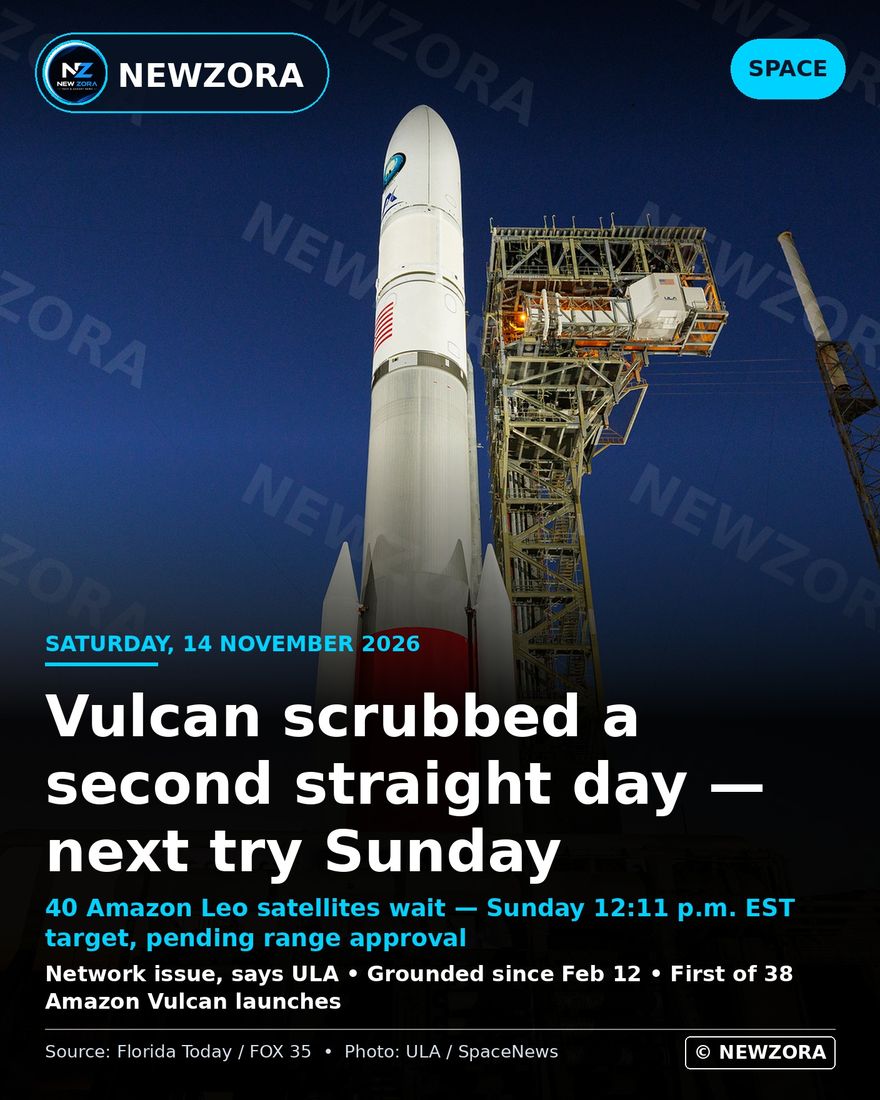
Vulcan fails — ULA's first total mission loss: 40 Amazon Leo satellites lost
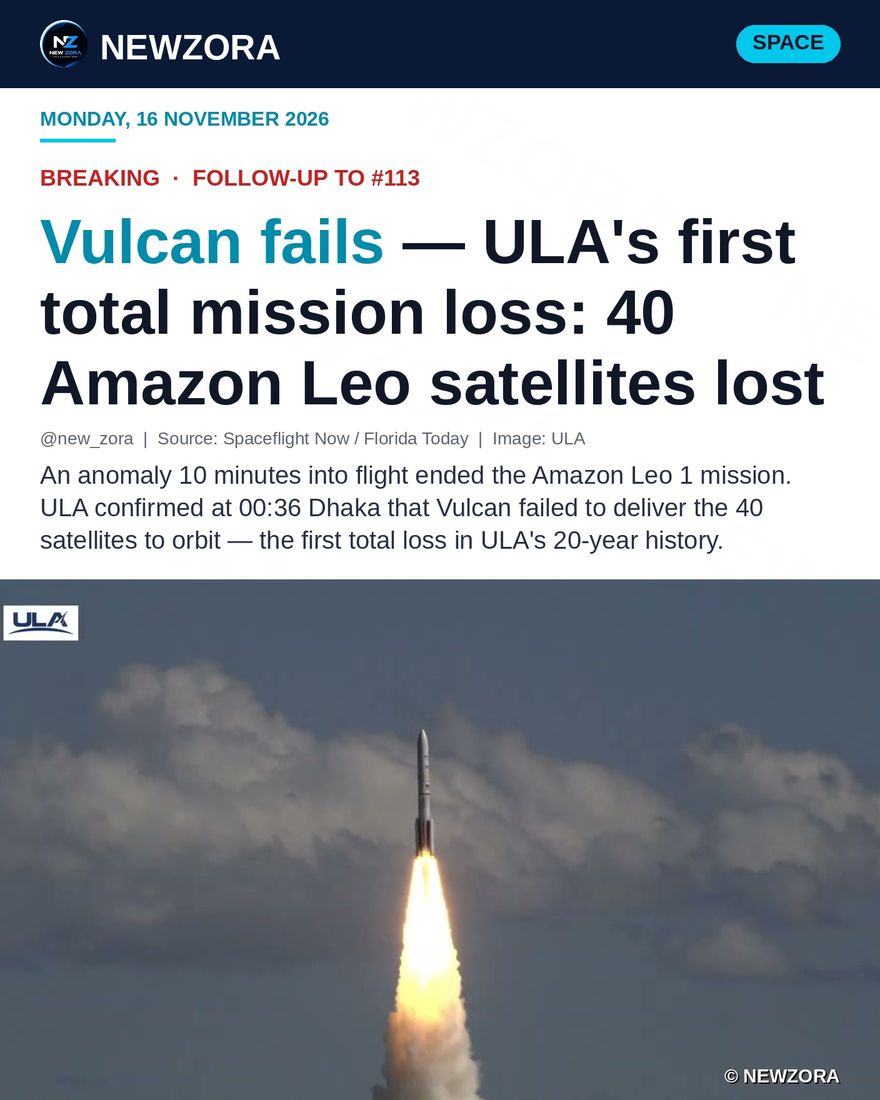
The launch
The Vulcan VC6L rocket lifted off from Space Launch Complex 41 at Cape Canaveral Space Force Station in Florida on Sunday, 15 November, at approximately 12:40 p.m. Eastern Time, equivalent to 23:40 in Dhaka. The mission, designated Amazon Leo 1, carried 40 satellites for Amazon's Leo broadband constellation. It was the first Vulcan flight since February 2026 and the first flight of the 38-launch campaign under which Vulcan is contracted to deploy the majority of Amazon's first-generation constellation.
The early phase of the flight proceeded as planned. All six solid rocket boosters separated cleanly at approximately T+1 minute 45 seconds. According to United Launch Alliance, the anomaly occurred approximately 10 minutes into the flight, at approximately 23:50 in Dhaka, well before the planned deployment sequence. Deployment of the satellites was not scheduled until approximately 70 minutes after liftoff, and no satellite was deployed before the failure.
Confirmation from United Launch Alliance
United Launch Alliance confirmed the loss of the mission at 1:36 p.m. Eastern Time on 15 November, equivalent to 00:36 in Dhaka on 16 November, in a statement issued by the company. The statement read: "Based on data received by our Launch Director, we confirm that the Vulcan vehicle launched from Space Launch Complex 41 suffered an anomaly 10 minutes into the flight and failed to deliver the Amazon mission to orbit."
The company has not identified a cause. In its communications following the confirmation, United Launch Alliance stated that it did not yet have specific data on the cause of the anomaly, and no technical explanation has been offered. Any account of the cause at this stage would be speculation, and none is presented here. The company has also not published information about the location of any debris or the re-entry of vehicle components, and no such information is included in this article.
A first for United Launch Alliance
The failure is the first total mission failure in the 20-year history of United Launch Alliance. The distinction is material. Vulcan has experienced nozzle-related incidents on two earlier flights, in October 2024 and on 12 February 2026, but in both cases the vehicle continued to orbit and completed its mission. The present flight is the first in which a United Launch Alliance vehicle failed to deliver its payload to orbit.
The record also requires a correction to one point that has appeared in some early coverage. Vulcan was not continuously grounded since 2024. The vehicle returned to flight in August 2025 with the USSF-106 national security mission, and the Amazon Leo 1 flight was its first launch since February 2026, following a pause that included the investigation of the February nozzle incident.
Consequences for Amazon Leo
All 40 satellites carried by the flight were lost. The loss is a direct setback to Amazon's Leo constellation, a first-generation network planned at 3,236 satellites. The 38-launch Vulcan campaign that forms the backbone of the deployment schedule is now in doubt pending the outcome of the failure investigation, because the schedule assumed a cadence of successful Vulcan flights that this failure interrupts.
Amazon has not issued a public statement on the failure at the time of writing, and no replacement launch date has been announced. Any statement attributed to Amazon, and any revised schedule, should be treated as unverified until the company or United Launch Alliance publishes it.
The failure also has consequences beyond the commercial programme. The United States Space Force had been waiting on data from this flight before lifting a pause on Vulcan for national security missions, following the February 2026 nozzle incident. That decision now depends on the findings of the investigation into this failure, and the pause remains in effect until the Space Force is satisfied.
The investigation ahead
NASA Administrator Jared Isaacman offered NASA's assistance in the investigation at approximately 00:42 in Dhaka on 16 November, shortly after United Launch Alliance confirmed the failure. The offer is consistent with standard practice after a launch failure involving a vehicle that also serves government missions, although the precise form of any NASA involvement has not been disclosed.
The investigation will determine the cause of the anomaly, the sequence of events after booster separation, and the corrective actions required before Vulcan returns to flight. Until its findings are published, the scale of the delay to Amazon's constellation deployment and to the Space Force's national security manifest cannot be quantified with confidence. What is established at present is narrow and unambiguous: the vehicle lifted off on schedule, its boosters separated cleanly, an anomaly occurred 10 minutes into flight, the mission failed to reach orbit, and all 40 satellites were lost. Those facts, confirmed by United Launch Alliance, are the basis of this report, and further reporting will follow as verified information becomes available.
Sources
United Launch Alliance statement, 15 November 2026; Spaceflight Now; Florida Today live coverage; NASASpaceFlight. The reference photograph is a frame from United Launch Alliance's official webcast of the launch.
More in Space
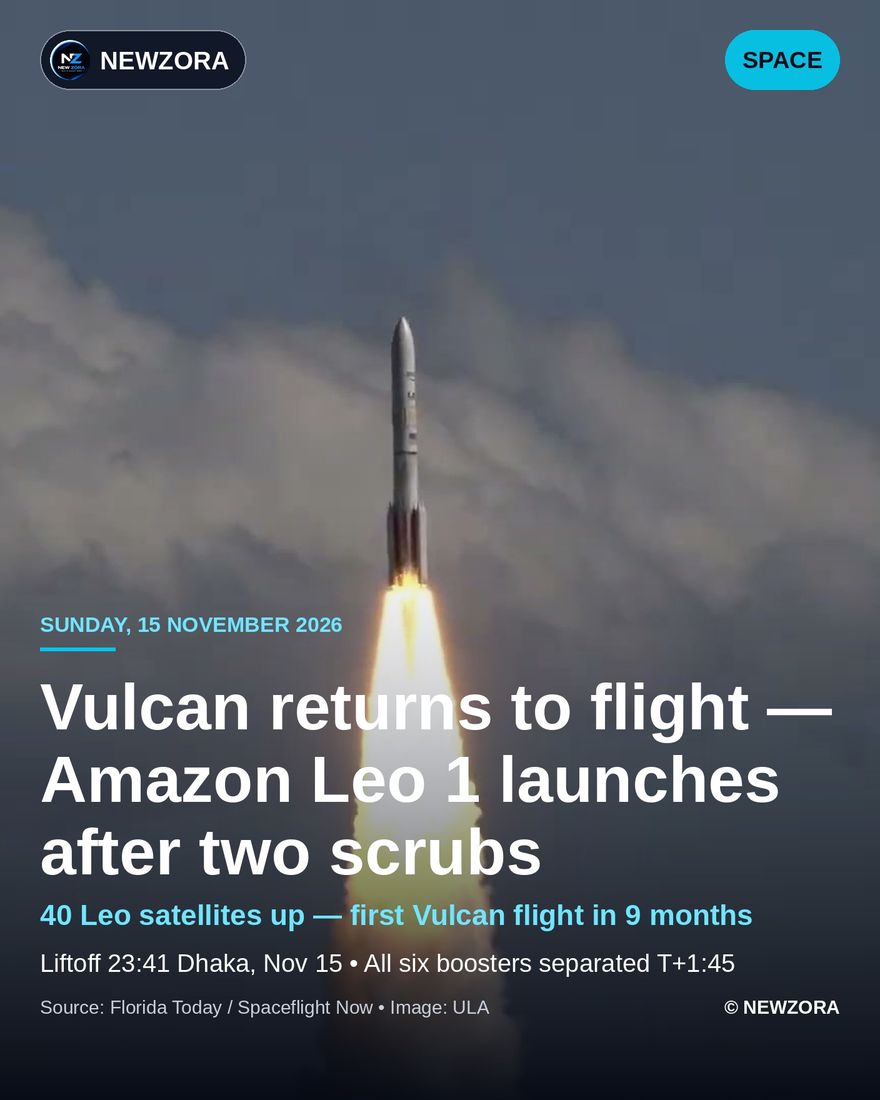
Vulcan returns to flight — Amazon Leo 1 launches after two scrubs
Mechazilla catches Starship — Ship 42 returns from orbit