ULA postpones Vulcan's return-to-flight launch — Amazon Leo launch slips to Saturday after fueling-plant power failure
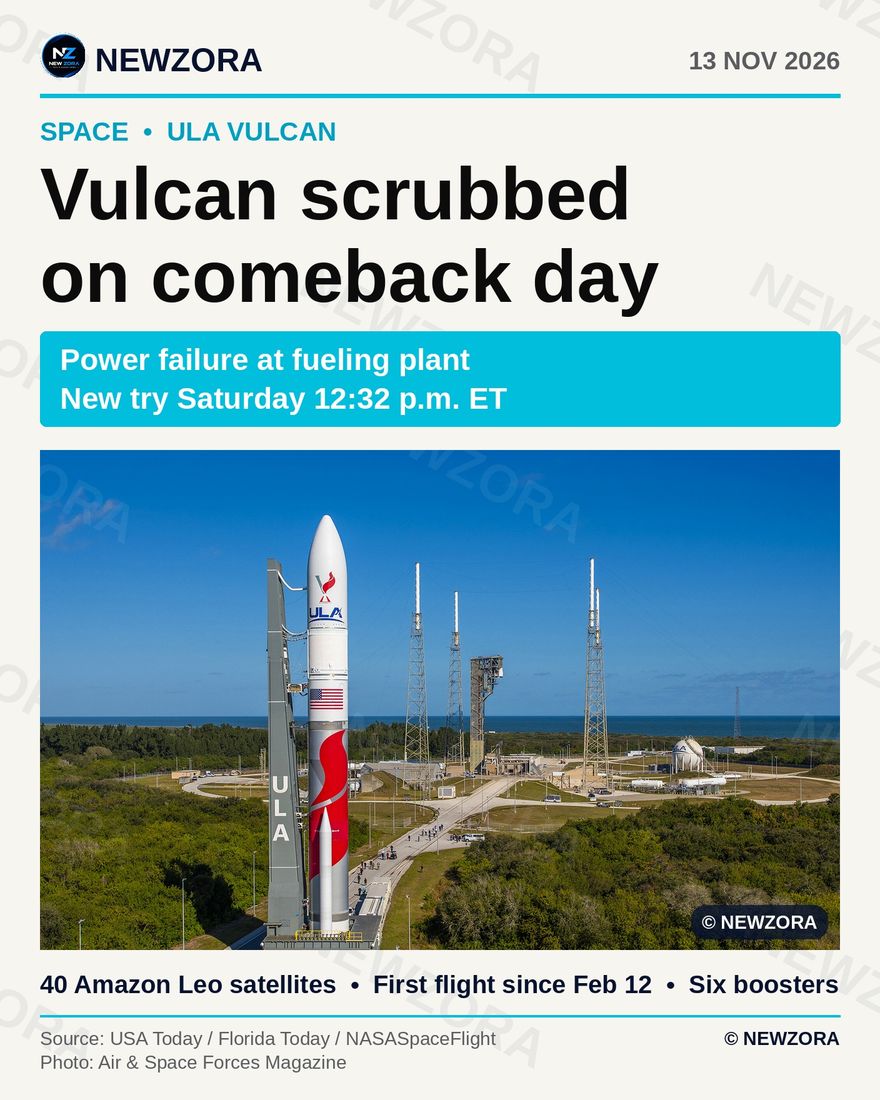
United Launch Alliance scrubbed the return-to-flight launch of its Vulcan Centaur rocket on Friday, November 13, 2026, during fueling, roughly three hours before the scheduled 12:54 p.m. ET liftoff from Cape Canaveral Space Force Station in Florida. The mission, designated LV-01, was to carry 40 Amazon Leo broadband satellites into orbit and would have been the first Vulcan flight since a booster anomaly grounded the vehicle in February 2026. United Launch Alliance has set a new launch window for Saturday, November 14, from 12:32 p.m. to 1:01 p.m. ET.
What Happened
The launch countdown was halted during the fueling phase, according to United Launch Alliance. The company attributed the scrub to a power interruption at the Air Liquide gaseous nitrogen plant serving the launch facility, which affected the facility's high-pressure pumps. United Launch Alliance did not disclose the duration of the interruption or the precise sequence of events that led to the decision to stand down, and no further technical detail was made public in the material reviewed for this article.
The rocket and the spacecraft remained healthy after the scrub, according to United Launch Alliance. The company stated that the vehicle and its payload were in a safe condition following the decision to halt the countdown, and that preparations for the rescheduled attempt would proceed.
The new launch window opens at 12:32 p.m. ET on Saturday, November 14, and closes at 1:01 p.m. ET. The window therefore spans 29 minutes. In Bangladesh Standard Time, the window runs from 11:32 p.m. on Saturday, November 14, to 12:01 a.m. on Sunday, November 15.
The Cause
The scrub was caused by a ground-system failure rather than a fault in the launch vehicle. The power interruption occurred at a gaseous nitrogen plant operated by Air Liquide, a supplier to the launch facility. Gaseous nitrogen is used in ground support operations at the launch site, and the interruption affected the high-pressure pumps at the facility. United Launch Alliance attributed the scrub to this ground-system event and did not report any anomaly in the Vulcan rocket itself or in the Amazon Leo spacecraft.
The distinction matters because it determines the scope of the work required before the next attempt. A ground-system power interruption can, in principle, be resolved by restoring the affected facility and verifying its systems, without the inspections and engineering reviews that a vehicle anomaly would require. Whether the rescheduled attempt proceeds on Saturday will depend on the condition of the ground systems and on weather and range conditions at the time.
The Mission
The payload for LV-01 consists of 40 Amazon Leo broadband satellites. This is the first time an Amazon Leo payload has flown on a Vulcan rocket, and the mission is the first of up to 38 Vulcan launches that Amazon has booked for the deployment of its broadband constellation. The scale of the booking makes United Launch Alliance a central launch provider for the Amazon Leo programme, and the outcome of this flight carries significance beyond a single mission.
The LV-01 flight is also the first in which Vulcan flies with the maximum configuration of six solid rocket boosters. In this VC6L configuration, the vehicle stands 215 feet tall. The additional boosters provide the thrust required to carry the 40-satellite payload, and their first use in this configuration is itself a test of the vehicle's heaviest standard arrangement.
Background
The Vulcan Centaur made its debut flight in January 2024. LV-01 will be the fifth Vulcan flight overall. The vehicle has been grounded since February 12, 2026, when a booster anomaly occurred during the USSF-87 mission for the United States Space Force. The grounding has lasted approximately nine months, during which the vehicle did not fly.
The return to flight is therefore a significant milestone for United Launch Alliance. The company has not flown its flagship heavy-lift vehicle for most of 2026, and the successful resumption of Vulcan operations is a precondition for the launch cadence required by the Amazon Leo booking and by the company's other contracted missions.
The photograph accompanying this article is a file photo of a Vulcan Centaur on the transporter at Space Launch Complex 41, Cape Canaveral Space Force Station. It shows a Vulcan vehicle at the launch complex and does not depict the LV-01 vehicle itself.
Why It Matters
The scrub delays, by at least a day, the resumption of Vulcan operations after a nine-month grounding. For Amazon, the delay postpones the first deployment of its Leo satellites on the vehicle that is scheduled to carry the majority of its constellation launches. For United Launch Alliance, the return to flight is a test of both the vehicle and the ground systems that support it, and the cause of the scrub — a failure in a supplier's ground facility — illustrates that the reliability of a launch depends on infrastructure beyond the rocket.
The incident also underlines the dependence of launch operations on industrial suppliers. The gaseous nitrogen plant is operated by Air Liquide, not by United Launch Alliance, and the interruption in its power supply was sufficient to halt a launch countdown. The arrangement is routine in the launch industry, where ground support equipment is supplied by specialist firms, but the scrub demonstrates that a failure at any point in that chain can stop a mission.
What Happens Next
United Launch Alliance will attempt the launch again on Saturday, November 14, within the 12:32 p.m. to 1:01 p.m. ET window. Whether the attempt proceeds will depend on the restoration and verification of the ground systems affected by the power interruption, and on the weather and range conditions at Cape Canaveral on the day. The company has not stated what would follow if the Saturday window is also missed, and no further backup date has been made public in the material reviewed for this article.
Source: USA Today / Florida Today / NASASpaceFlight (Nov 13, 2026)
More in Space
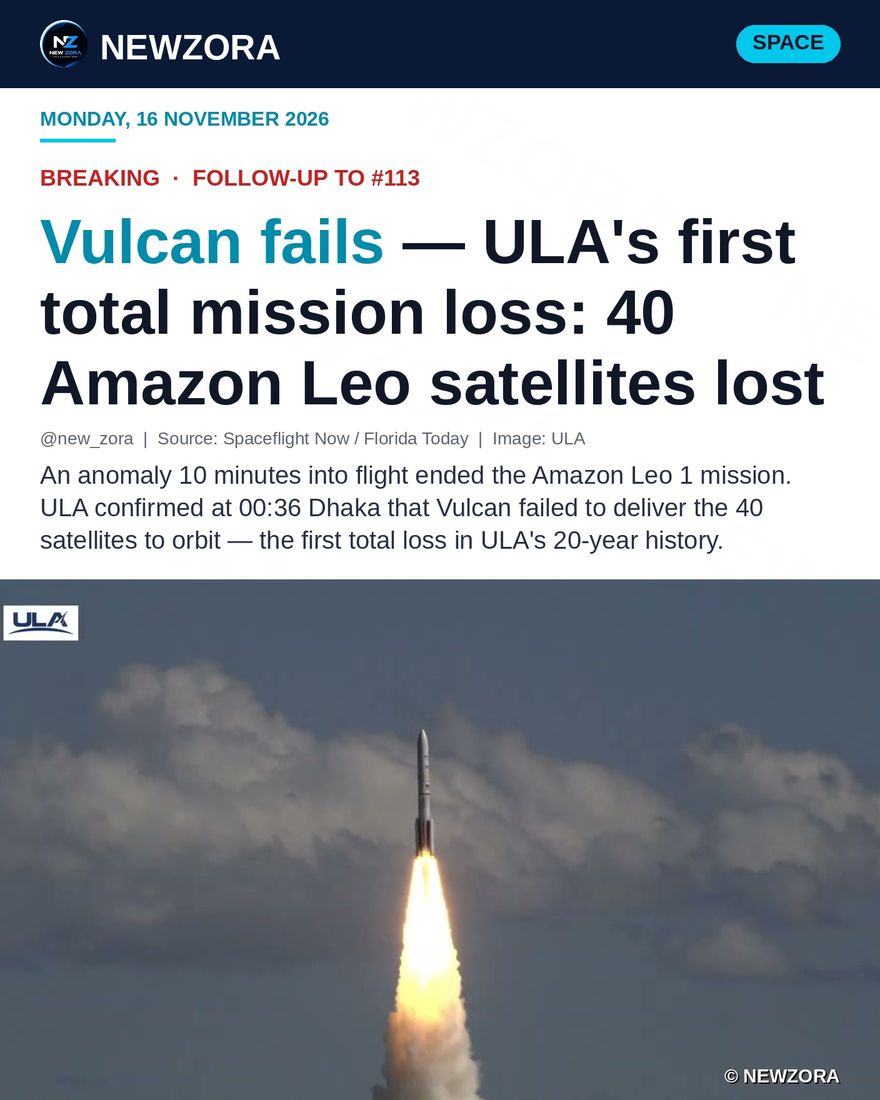
Vulcan fails — ULA's first total mission loss: 40 Amazon Leo satellites lost
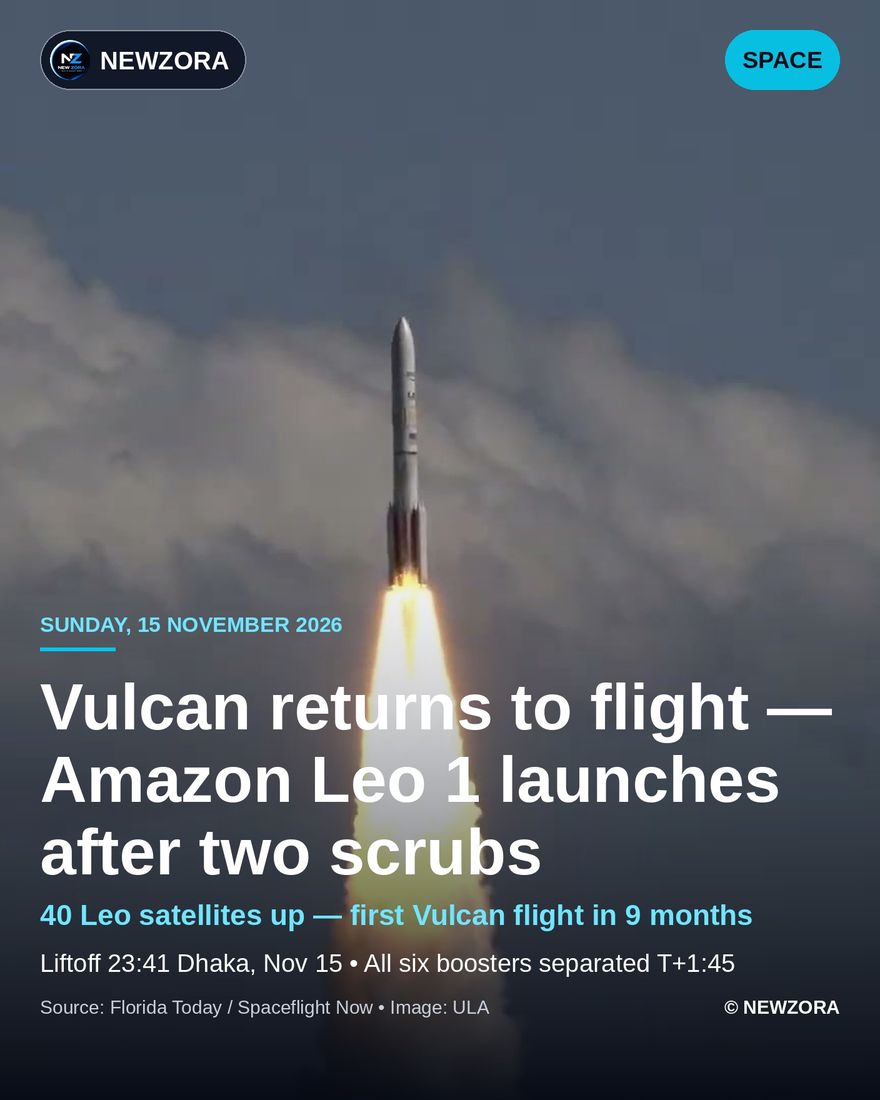
Vulcan returns to flight — Amazon Leo 1 launches after two scrubs