
Apple tightens Mac security as AI agents demand full disk access
What Apple announced
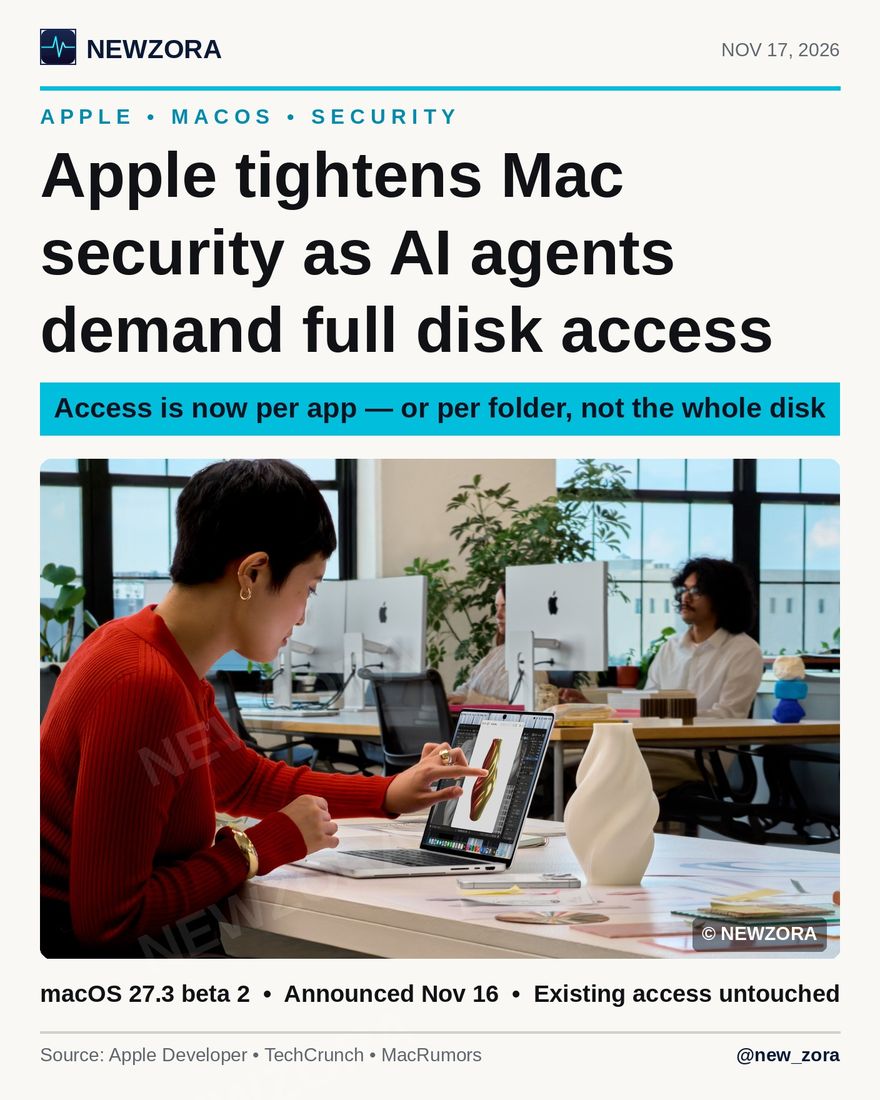
On 16 November 2026, Apple published a developer post setting out revisions to macOS permission controls. The post was reported the same day by TechCrunch, MacRumors and 9to5Mac. The changes are contained in macOS 27.3 beta 2, which is a developer beta. They are not part of a public release of macOS 27.3, and Apple has not announced a public release date. Reports from Macworld and MacRumors indicate that a public release is expected in December, but that timing is an expectation reported by those outlets, not a date announced by Apple.
A restructured permission
At the centre of the announcement is a change to a macOS control previously known as Device Control and Data Access. Under macOS 27.3 beta 2, that single control is divided into two separate permissions: System and App Protection Override, and Accessibility. The division separates two distinct capabilities that had previously been governed together: the ability to override system and application protections, and the ability of one application to control another application.
Apple has also changed how a user grants these permissions. Under the revised system, there is a single method of granting access: the user selects the requesting application from a list. The change replaces the previous arrangement in which access could be granted through more than one route.
Narrower grants and clearer consent
The revised controls give users the ability to limit the scope of what an application may access. Under System and App Protection Override, a user can limit access to specific applications rather than granting it broadly. Under Full Disk Access, a user can limit access to specific folders rather than granting access to the entire disk. Users can also configure an application so that it must ask for permission every time it seeks access, rather than receiving a standing grant.
Apple has also added a transparency measure. A new indicator in the menu bar shows when an application is controlling another application, giving the user a visible signal that such control is active. In addition, the permission prompts provide more detail about what an application will be able to access or control before the user grants permission, so that consent is given on the basis of clearer information about the request.
What does not change
Several aspects of the existing system remain unchanged. Permissions that users have already granted are not affected by the revision. Full Disk Access is not being removed. The changes do not prevent users from installing or running AI agents on a Mac. These points matter because the announcement concerns the conditions under which deep access is granted, not the availability of the applications that request it.
Apple has also made provision for applications that depend on the previous behaviour. Backup and assistive applications can request entitlements that allow them to retain the pre-27.3 experience on new installations of macOS, so that software whose function depends on broad access can continue to operate as before.
Background: an October warning
The November announcement follows an earlier statement from Apple. In October 2026, Apple said it would introduce additional controls over the permissions that govern deep access on the Mac. In a developer post published on 2 October 2026, Apple wrote: "As AI agents become increasingly capable and autonomous, the risks associated with this level of access will grow substantially." The 16 November developer post itself does not mention AI or agents. The connection between the new controls and AI agents therefore rests on Apple's October warning and on the framing adopted by the outlets reporting the announcement, rather than on any statement made by Apple on 16 November.
The context in which the announcement was received is also relevant. TechCrunch, in its reporting, noted recent discussion of the risks associated with AI agents operating with broad system access, including a reported flaw in a Mac application and a separate claim concerning a messaging service. Those references are part of the outlet's context for the story. They are not presented by Apple as reasons for the changes, and they should not be treated as established facts about the causes of Apple's decision.
Why it matters
The significance of the changes lies in the relationship between capability and consent on the Mac. Applications that can read the contents of a disk or control other applications hold a level of access that, if granted broadly and without scrutiny, exposes a user's files, messages and working environment. AI agents, which act on a user's behalf and may operate across many applications at once, are among the applications most likely to request such access, and the most likely to benefit from it. By allowing users to narrow a grant to specific applications or folders, and to require a fresh request each time, Apple reduces the exposure created by a single broad permission without removing the functionality that depends on it.
The menu-bar indicator adds a further layer of accountability. Where previously an application could control another application without any persistent visible sign, the user now has a continuous indication that such control is taking place. Taken together, the changes shift the balance of the permission system towards smaller, more specific and more visible grants.
What happens next
The changes are currently available only in the macOS 27.3 developer beta. Developers and users testing the beta will be able to examine the new permission structure and the revised prompts. A public release is expected in December, according to Macworld and MacRumors, but Apple has not confirmed a date. Until a public release, the practical effect of the changes is limited to those running the developer beta, and the wider question of how backup, assistive and AI agent applications adapt to the new controls will be answered as those applications are updated for macOS 27.3.
Sources
- Apple Developer, TechCrunch, MacRumors, 9to5Mac