OpenAI launches ChatGPT Wallet
What ChatGPT Wallet does
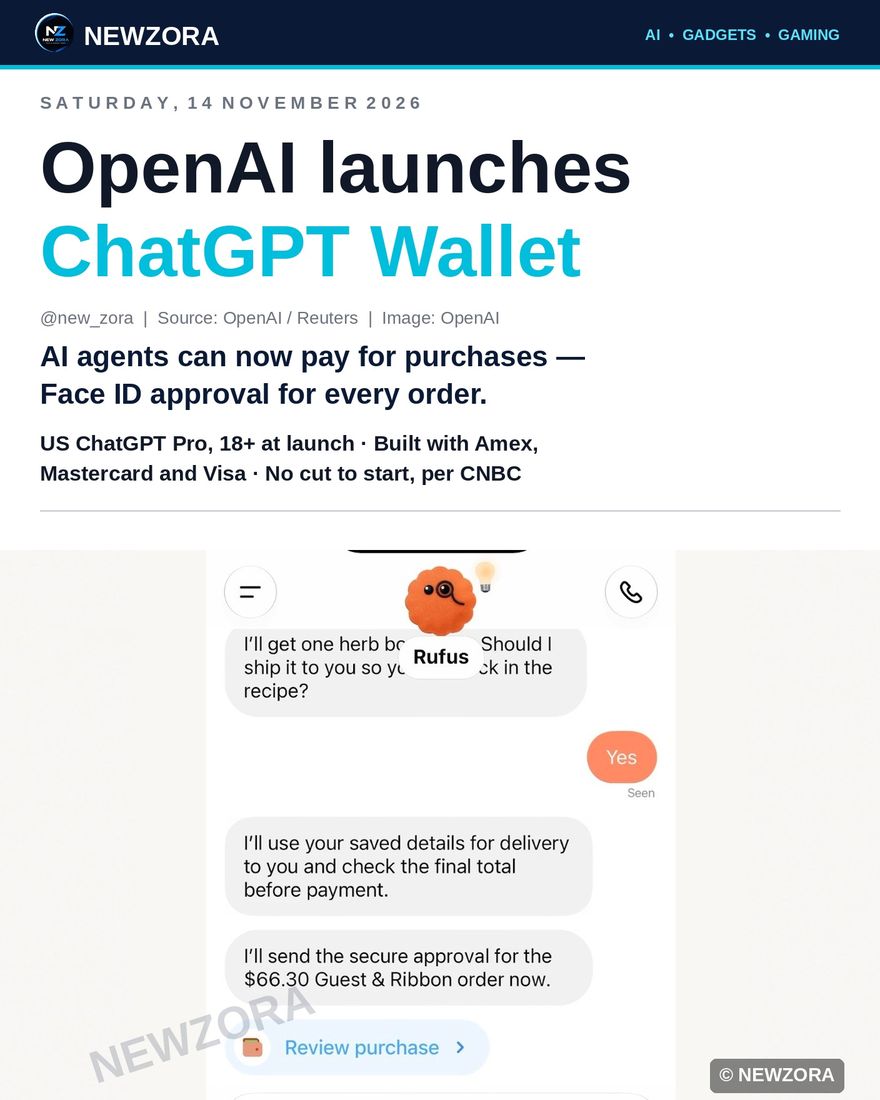
ChatGPT Wallet stores a user's payment card and makes it available to OpenAI's "dots" agents, the autonomous AI agents introduced alongside the announcement that can carry out multi-step tasks inside ChatGPT. When a user asks an agent to buy something, the agent assembles the order, and the user reviews the items, the total amount and the selected card before approving the transaction with a biometric check, either Face ID or a fingerprint. Approval creates a record of the authorised purchase.
The mechanism that protects the card is tokenisation. According to OpenAI, the payment network issues a one-use token for each transaction, consisting of a substitute card number, security code and expiry date. Neither the agent nor the merchant receives the user's real card details. OpenAI describes the product as the first wallet that lets agents pay without access to users' actual card details and that requires a security check for every purchase, a characterisation that is the company's own claim.
How the product was built
OpenAI developed the wallet in partnership with the major card networks. American Express, Mastercard and Visa are launch partners, and Chase cards are also eligible. The involvement of the networks matters because tokenisation and the biometric approval step depend on infrastructure they operate. The system is built on the card networks' existing token services, which replace sensitive card data with single-use substitutes for individual transactions.
The launch also reflects the scale of ChatGPT itself. OpenAI reports that 1.2 billion people use ChatGPT each week, a user base that gives the company a distribution advantage no conventional wallet can match. A payment capability embedded in a product of that scale could, if adopted, move a material share of everyday online purchasing into agent-mediated transactions.
Availability and limits
Availability at launch is narrow. ChatGPT Wallet is initially offered to ChatGPT Pro subscribers in the United States who are aged 18 or older, using eligible US-issued cards, and only inside "dots" agent sessions. It is not available in Chat, Work or standalone Codex threads. Credit cards only are supported at launch; debit cards are not. OpenAI has said the wallet will roll out gradually, though it has not published a timetable for broader availability or for access by Plus or free-tier users.
The commercial terms are also provisional. According to a CNBC interview with OpenAI executive Chaya Nayak, OpenAI is not taking a cut of transactions to start. The wording is important: the absence of a transaction fee is a starting position, not a permanent commitment, and the company has given no indication of what its eventual monetisation model will be.
Why agents need a wallet
The wallet addresses a practical obstacle that has constrained autonomous AI agents since their introduction. An agent that can research, compare and select a product cannot complete the task without a way to pay, and handing a real card number to an agent — or to the merchant the agent transacts with — creates obvious risks. Existing approaches, such as asking the user to type card details into a checkout page, break the autonomous workflow and reintroduce the manual step the agent was meant to remove.
ChatGPT Wallet attempts to resolve this by separating authorisation from disclosure. The user authorises a specific purchase, with the items and total visible, and the payment is executed with a token that is useless after a single transaction. The design echoes the logic of Apple Pay and Google Pay, which also substitute tokens for real card numbers, but applies it to a setting in which the buyer is software acting on instruction rather than a person at a checkout.
Why it matters
The launch is significant for three reasons. First, it converts ChatGPT from a research and drafting tool into a transaction channel, extending OpenAI's presence from the information layer of the internet into its commercial layer. Second, it establishes a template for agent payments that competitors are likely to follow or challenge: biometric approval for every purchase, one-use tokens, and no direct exposure of card details. Third, it raises the stakes of the trust question that underlies the entire agentic AI project. A wallet that an agent can use is useful only to the extent that users believe the agent will buy the right item, at the right price, from the right seller.
What happens next
The immediate question is adoption within the initial Pro subscriber base and whether OpenAI extends the wallet to Plus and free users, to debit cards, and to users outside the United States. A second question is whether merchants and rival platforms adopt compatible approaches, or whether payment becomes a point of competition between AI providers. A third is regulatory: agent-mediated purchases will test consumer-protection rules written for transactions in which the buyer is a person.
OpenAI has not disclosed transaction volumes, merchant numbers or a schedule for expansion. The wallet's success will be measured by whether users who try it once continue to let agents spend on their behalf.
Source: OpenAI blog and Reuters, 13 November 2026.