
Microsoft signs Cerebras as third hyperscaler
The earnings result
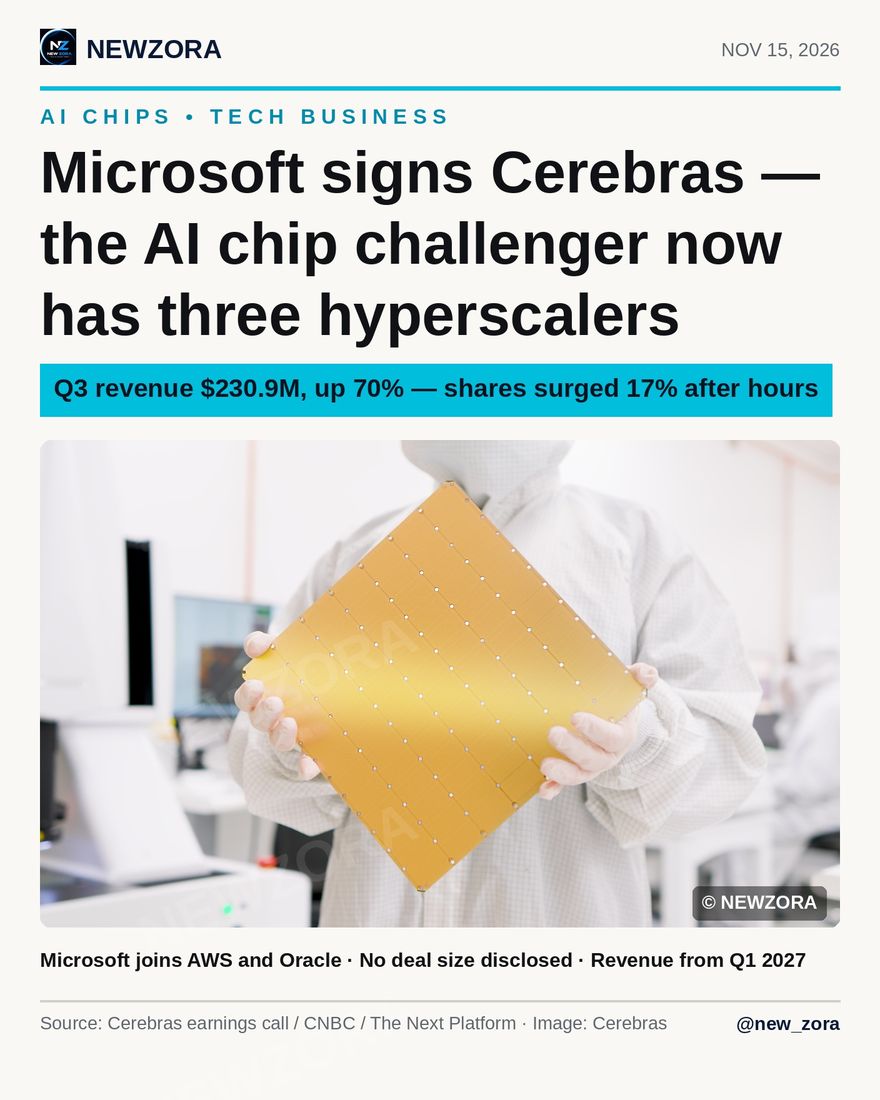
Cerebras reported core revenue of $230.9 million for the third quarter of 2026, an increase of 70 percent compared with $135.7 million in the corresponding quarter a year earlier. The figure exceeded the $214.7 million consensus estimate compiled by LSEG. On a generally accepted accounting principles basis, revenue was $210.8 million, an increase of 55 percent year on year.
The strongest growth came from the core cloud and services business, where revenue reached $144.9 million, an increase of 272 percent year on year. Remaining performance obligation, a measure of contracted revenue not yet recognised, stood at $26.1 billion at the end of the quarter.
For the fourth quarter, Cerebras guided core revenue to a range of $310 million to $330 million. The company raised its full-year core revenue guidance to $940 million to $960 million, from a previous range of $880 million to $890 million. Management stated that revenue is expected to roughly triple in 2027.
The Microsoft agreement
The most consequential disclosure of the call concerned a customer the company had not previously named. Chief executive Andrew Feldman stated: "we signed an important cloud deal with Microsoft, which along with the AWS and Oracle announcements previously made brings us to 3 hyperscalers."
The agreement was signed in October 2026. Cerebras did not disclose the size of the deal, its price, or its terms, and Microsoft has not commented on the agreement. The earnings release itself did not name Microsoft; the identification of the customer rests on Feldman's remarks on the call and a subsequent interview with CNBC.
Revenue from the Microsoft agreement is expected to begin to appear in the first quarter of 2027. Cerebras indicated that further detail on the arrangement would follow in the first half of 2027.
The market response
Investors responded positively to the results and the disclosure. Cerebras shares rose approximately 17 percent in after-hours trading on 12 November, following the earnings release. The shares rose approximately 12 percent in trading on Friday 13 November.
The reaction reflects the significance of a third hyperscaler for a company of Cerebras's scale. The market for AI accelerators is dominated by Nvidia, and a challenger that can demonstrate demand from the largest cloud operators carries a different valuation case from one dependent on a small number of customers. The Microsoft agreement, together with the previously announced AWS and Oracle relationships, places Cerebras in commercial relationships with three of the largest buyers of AI compute capacity.
The next system: WSE-5 and CS-5
Cerebras also provided an update on its next-generation hardware. The WSE-5, the company's fifth-generation Wafer-Scale Engine, taped out on 15 June 2026 and returned from fabrication ahead of schedule, according to The Next Platform. The chip is already running models and is in chassis-level testing.
The CS-5 system, built around the WSE-5, is expected to deliver more than double the speed of the CS-4 system it replaces. The WSE-5 is built on TSMC's 5-nanometre process. Production of the CS-5 is scheduled to begin in early summer 2027.
The timing matters because it aligns the next hardware generation with the ramp in demand implied by the company's guidance. A tripling of revenue in 2027 would require both sufficient manufacturing capacity and systems ready to ship at scale, and the CS-5 schedule places new hardware in production in time for that ramp.
Delivery constraints
The call also addressed delays in deliveries to OpenAI, one of Cerebras's largest customers. Deliveries on initial tranches are running behind schedule. According to the company, the cause is the availability of land, power and buildings at the relevant sites, rather than any problem with the silicon itself.
Cerebras stated that cancellation exposure amounts to less than 5 percent of committed megawatts this year, and that delay credits have been deducted from remaining performance obligation. The distinction is material: a delay caused by site infrastructure is a scheduling problem, whereas a delay caused by the hardware would raise questions about the product itself.
Why it matters
The Microsoft agreement changes the shape of Cerebras's customer base. Three hyperscalers provide a broader foundation for the revenue growth the company has guided, and reduce dependence on any single customer. The scale of remaining performance obligation, at $26.1 billion, indicates that contracted demand already far exceeds current quarterly revenue.
At the same time, the disclosure leaves important questions unanswered. No deal size or terms were provided, and Microsoft has not commented, so the commercial weight of the agreement cannot yet be measured from public information. The company has indicated that more detail will follow in the first half of 2027, which sets the next point at which the agreement can be assessed on its economics rather than its existence.
What comes next
Three developments will determine whether the third quarter proves to be a turning point. The first is the fourth-quarter result, against guidance of $310 million to $330 million in core revenue. The second is the appearance of Microsoft revenue in the first quarter of 2027, which will provide the first measurable evidence of the new agreement. The third is the production ramp of the CS-5 system in early summer 2027, which must arrive on schedule if the company is to meet its expectation of roughly tripling revenue in 2027.
Source: Cerebras Q3 2026 earnings call (Motley Fool transcript) / CNBC / Data Center Dynamics / The Next Platform
More in AI

Asian governments react to Nvidia CEO Jensen Huang's exit

Musk: Nvidia will lose 'critical' deals without Jensen Huang