
SpaceX plans $74B+ AI supercomputing campuses in Texas and Arizona
The Announcement
According to reporting by Reuters on 12 November 2026, SpaceX intends to build the two campuses to support its expanding artificial intelligence operations. The company did not disclose a construction timetable for either site in the material reviewed for this article, and no completion date has been confirmed. The scale of the investment, if realised, would place the programme among the largest private infrastructure commitments announced for artificial intelligence computing in 2026.
The announcement follows a period in which demand for computing capacity for training and operating large artificial intelligence models has driven substantial capital expenditure across the technology sector. SpaceX has not published detailed technical specifications for the computing hardware the campuses would host, and the company did not disclose the intended customers for the capacity beyond its own artificial intelligence activities.
The Arizona Campus
The larger of the two proposals is located in Cochise County, Arizona. According to the reporting, the site is planned to reach up to 6 gigawatts of computing capacity at full build-out, delivered in four phases of approximately 1.5 gigawatts each. The development would comprise nine buildings of approximately 493,000 square feet each.
The project is expected to support approximately 5,500 construction jobs during the build phase and approximately 1,000 permanent positions once the campus is operating. The plans include 24 gigawatt-hours of battery storage and 90 megawatts of gas-fired backup generation, together with a 3.6 billion dollar investment in transmission infrastructure. The facility would use dry cooling and, according to the filings, has no planned industrial groundwater use, a point of significance in a region where water resources are a recurring subject of public debate.
The Arizona campus has not received final approval. Cochise County is scheduled to hold a public hearing in Bisbee on 9 December 2026, and the project still requires county approval before construction can proceed. A petition bearing approximately 2,400 signatures asks county officials to deny the permit. The outcome of the hearing will determine whether the project advances on its current terms, is modified, or is halted.
The Starbase Campus
The second campus is planned at Starbase, Texas, the site of SpaceX launch operations on the Gulf Coast. The investment at Starbase is described as more than 24 billion dollars. The facility would generate its own electricity through a gas-fired power plant, a design choice that reflects the scale of power demand involved and the limits of existing local grid capacity.
Construction at Starbase is expected to support more than 3,000 construction jobs, with more than 500 permanent positions once the campus is running. As with the Arizona proposal, a local decision is scheduled for 9 December 2026, when the Starbase City Commission is due to vote on a property-tax abatement for the project. The abatement decision is a separate matter from any construction permits, and the company has not stated whether the project would proceed on the same schedule without it.
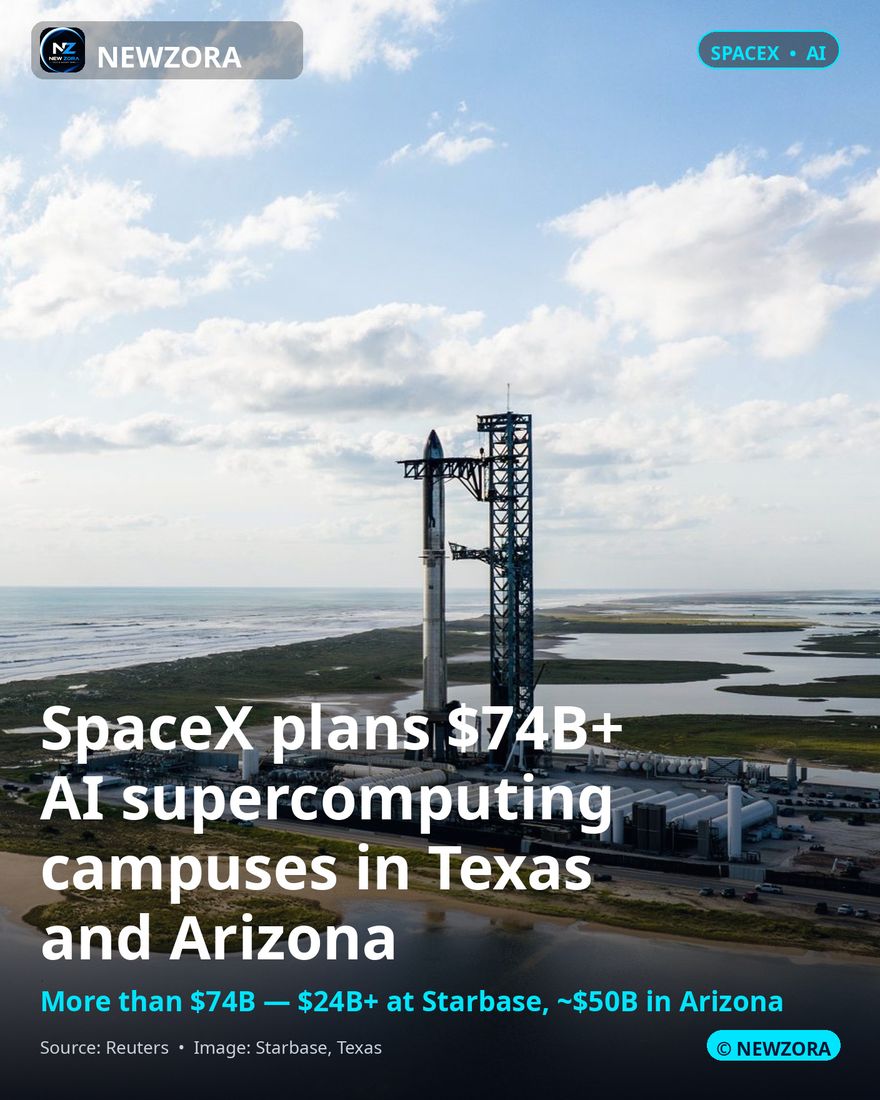
The imagery associated with the Starbase site shows the launch facility, including the Starship vehicle on its launch mount. The photographs depict launch infrastructure, not a data centre, and should not be read as a representation of the planned computing campus.
The Commercial Context
The scale of the proposed investment is consistent with the growing weight of artificial intelligence within SpaceX. According to the reporting, the company artificial intelligence segment generated more than half of its revenue in the third quarter of 2026. The company did not disclose the precise figure, and the reporting does not break down the segment revenue between internal use and external customers.
The figure indicates that artificial intelligence has moved from an ancillary activity to a central source of income for SpaceX within a short period. That shift provides the commercial rationale for infrastructure on this scale: computing capacity has become a direct determinant of revenue, rather than a supporting cost. The two campuses, if built, would give SpaceX control over a substantial share of its own computing supply at a time when capacity constraints have affected the wider industry.
Why It Matters
A combined investment exceeding 74 billion dollars would make SpaceX one of the largest private investors in artificial intelligence infrastructure in the United States. The Arizona campus alone, at up to 6 gigawatts, would rank among the largest computing facilities yet proposed, and its transmission investment of 3.6 billion dollars underlines the extent to which such projects now require dedicated energy infrastructure rather than incremental grid connections.
The proposals also illustrate the political and regulatory dimension of large-scale computing infrastructure. Both campuses face local decisions on 9 December 2026, and the Arizona project already faces organised opposition, with approximately 2,400 residents signing a petition against the permit. Questions of water use, energy supply, and local employment are now routine features of data centre approvals, and the Cochise County hearing will test whether the promised employment and investment outweigh local concerns.
The reliance on gas-fired generation at both sites, including the 90 megawatts of backup capacity in Arizona and the dedicated plant at Starbase, also raises questions about the energy mix of the artificial intelligence build-out. SpaceX has not published emissions estimates for either campus, and the company did not disclose the expected operating carbon intensity of the facilities.
What Happens Next
The immediate milestones are the two decisions scheduled for 9 December 2026: the Cochise County public hearing in Bisbee and the Starbase City Commission vote on the property-tax abatement. Until those decisions are taken, the Arizona campus remains unapproved, and the Starbase project remains subject to the terms of any abatement granted.
Further detail is expected on construction timelines, hardware suppliers, and the energy arrangements for both sites. Whether SpaceX proceeds with the full 6 gigawatt build-out in Arizona will depend in part on the outcome of the county process and on the continued growth of its artificial intelligence revenue. The announcements of 12 November establish the ambition; the decisions of 9 December will establish whether that ambition can proceed as planned.
Source: Reuters (12 November 2026 wire) / MLQ / Unite.AI / WSJ.
More in Tech Business
Microsoft's fix is failing as the 365 outage drags on

Reuters: Jensen Huang had a relationship with a second Nvidia employee