
Microsoft's fix is failing as the 365 outage drags on
The latest update from Microsoft
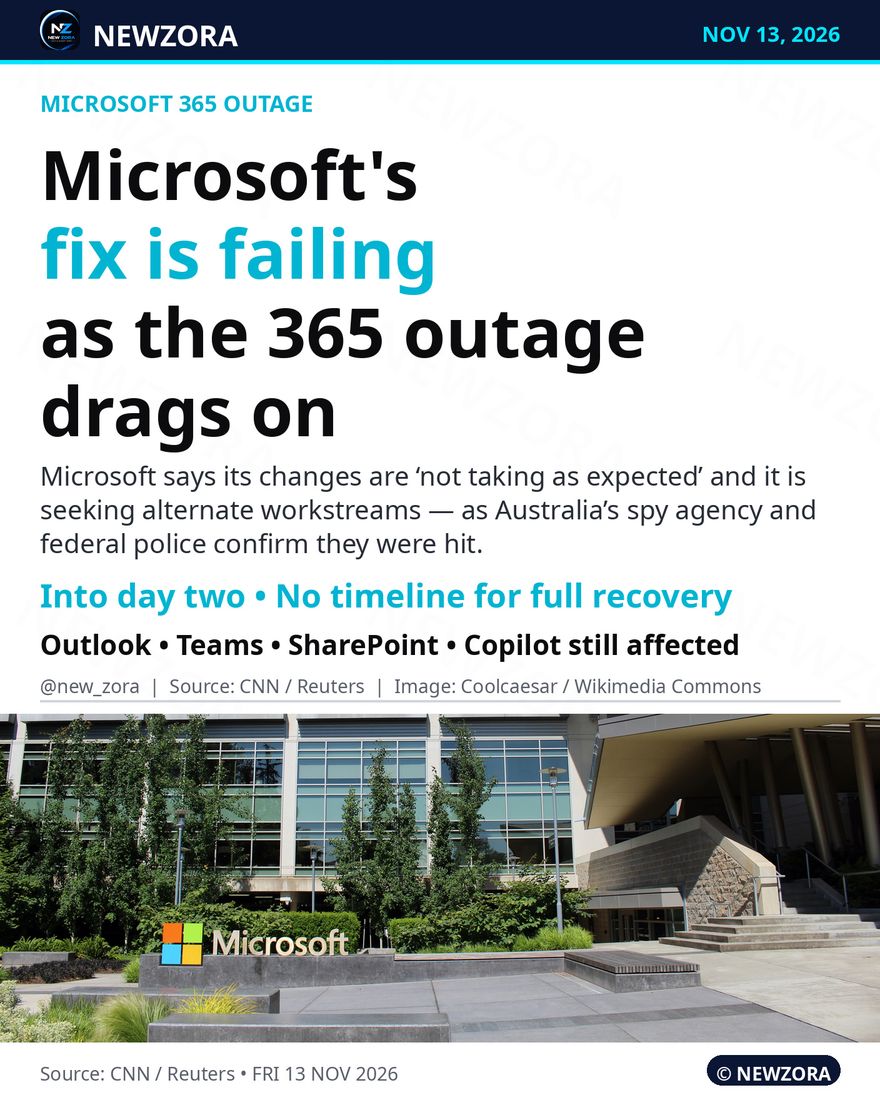
The Microsoft 365 Status account published a sequence of updates through the morning of 13 November that trace a pattern of partial progress followed by renewed difficulty. At 04:09 Dhaka time, the company stated that the actions taken thus far had not provided the anticipated relief. At 07:59, it reported that it was seeing positive results with efforts to restart affected infrastructure. The update issued at approximately 09:07 to 09:13 reversed that assessment. Microsoft stated that the changes applied to improve serviceability were not taking as expected, and that it was identifying alternate workstreams that could be applied to increase capacity in the face of sustained traffic management imbalances.
As of approximately 09:50 Dhaka time, the outage remained ongoing. Microsoft has provided no timeline for full recovery. The available evidence indicates partial and gradual recovery only. According to Microsoft, servers that have been restored can become unresponsive again when subjected to traffic, which indicates that the underlying capacity problem has not been resolved.
Scale of the disruption
The outage affects Outlook and Exchange Online, under incident identifier EX1550543, together with Teams, SharePoint Online, Microsoft 365 Copilot and Defender XDR, under incident identifier MO1550821. Microsoft To Do and Purview are also affected. In addition, the Microsoft 365 connectors offered by OpenAI and Anthropic have been disrupted, which extends the impact to third-party artificial intelligence services that depend on Microsoft 365 data access.
Downdetector, which records user-submitted reports of service problems, registered a peak of approximately 130,000 reports for Outlook and more than 47,000 reports for Microsoft 365. At approximately 09:00 Dhaka time, the figures remained elevated, at more than 24,000 reports for Outlook and more than 8,000 reports for Microsoft 365. These figures are counts of reports submitted to Downdetector. They are not counts of affected users, and they should not be read as such. The outage began at approximately 00:26 Dhaka time on Friday 13 November, corresponding to 1:26 PM Eastern Time on Thursday 12 November.
Impact in Australia
The disruption has affected Australian government organisations. The Director-General of the Australian Security Intelligence Organisation, Mike Burgess, and the Commissioner of the Australian Federal Police, Krissy Barrett, both confirmed that their organisations were affected, according to reporting by Reuters at 09:08 Dhaka time and by AAP at 06:18 Dhaka time. Burgess stated that the organisation operates on multiple levels, and that one level was affected but not completely. He described the impact as very much on the email system. The Department of Foreign Affairs and Trade and the Department of Agriculture, Fisheries and Forestry have issued notices concerning disrupted messaging and email.
The Home Affairs Minister, Tony Burke, stated that Microsoft does not believe the incident was a cyber attack. Australia has activated its formal cyber agreement with Microsoft in order to secure priority restoration. The activation of that agreement reflects the classification of the incident as a matter of national service continuity rather than a security breach. No evidence has been presented that any government system was compromised, shut down or breached, and no such claim is made here.
What Microsoft has said about the cause
Microsoft has attributed the outage to servers that became unexpectedly unavailable after failing automated health checks. According to the company, a core process on affected servers is becoming overwhelmed, causing capacity loss. Microsoft has stated that the elevated load was not driven by an increase in traffic. The company has not disclosed further technical detail about the process involved or the reason for its failure.
Microsoft executive Charles Lamanna has ruled out a cyber attack as the cause. That assessment is consistent with the statement by Minister Burke. No independent technical analysis of the root cause has been published at the time of writing, and the company has not provided a date by which a definitive explanation will be available.
Why recovery is proving difficult
The sequence of Microsoft updates indicates that the difficulty lies in restoring capacity faster than demand overwhelms it. Restarting affected infrastructure produced positive results at 07:59, but the changes applied to improve serviceability were judged ineffective by 09:07. Microsoft described the problem in terms of sustained traffic management imbalances, which suggests that the system cannot yet absorb the volume of requests directed at it even after servers are brought back online.
The pattern is consistent with the warning that restored servers can become unresponsive again under traffic. Recovery in such circumstances is not a single event but a gradual process in which capacity is rebuilt while load is managed. Microsoft has not stated how much additional capacity is required, nor how long the alternate workstreams now under consideration will take to implement.
Why it matters
Microsoft 365 is a core productivity platform for businesses, schools and government agencies in many countries. Outlook is the primary email and calendaring service for a large share of those organisations, and Teams and SharePoint support their daily communication and document work. An outage that extends into a second day disrupts scheduled meetings, delays correspondence and forces organisations to fall back on alternative channels that may not be integrated with their existing workflows.
The incident also matters because of the contrast between the scale of the platform and the fragility exposed by the failure. A single overwhelmed process on a subset of servers was sufficient to produce a global disruption that persisted for more than nine hours. The episode will prompt questions about redundancy, health-check design and the capacity margins maintained for services that millions of organisations treat as essential infrastructure.
What happens next
Microsoft has stated that it is identifying alternate workstreams to increase capacity. No further detail has been provided about the nature of those workstreams or the sequence in which they will be applied. Users should expect continued intermittent availability until Microsoft reports that capacity has been restored to a stable level. The company has not indicated when a full post-incident report will be published.
Newzora will continue to monitor the Microsoft 365 Status account and official Microsoft communications and will report further developments as verified information becomes available.
Source: CNN / USA Today / Times of India / Reuters / CNA / AAP / Indian Express — Microsoft 365 Status updates, 13 November 2026. Follow-up to Newzora report 72.
More in Tech Business

SpaceX plans $74B+ AI supercomputing campuses in Texas and Arizona

Reuters: Jensen Huang had a relationship with a second Nvidia employee