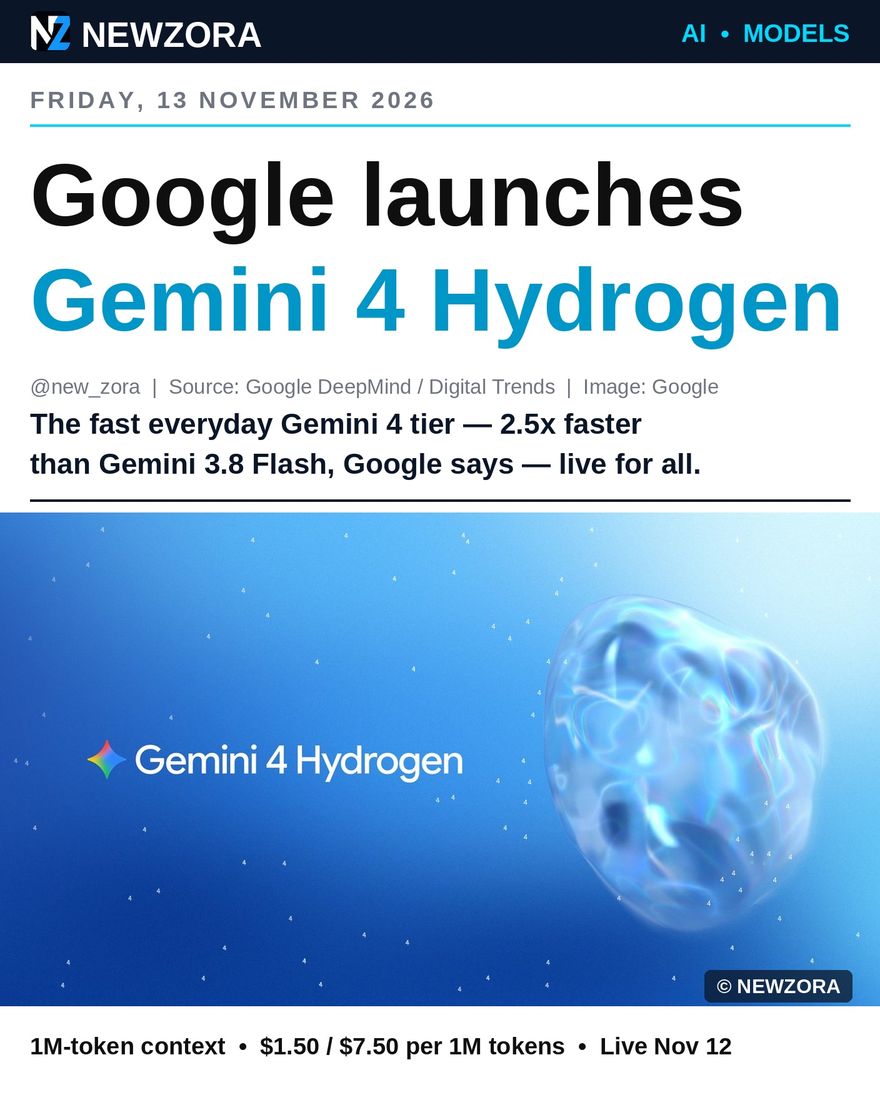
Google launches Gemini 4 Hydrogen
The Gemini 4 family and Hydrogen's role
Gemini 4 Hydrogen is the fast, everyday execution tier of the Gemini 4 family. Carbon and Argon, by contrast, are the frontier tiers, built for deep reasoning. Newzora reported the launch of Gemini 4 Carbon on 11 November 2026, one day before the Hydrogen announcement. Hydrogen is therefore not the first Gemini 4 model to reach the public; it is the speed-oriented counterpart to the frontier tiers already announced.
Google presents Hydrogen as a successor and a major upgrade path for teams migrating from Gemini 3.8 Flash, the previous fast model in the Gemini line. Google has not stated that Gemini 3.8 Flash is retired, and no such claim should be inferred from the announcement.
Performance and speed
Google claims that Hydrogen runs 2.5 times faster than Gemini 3.8 Flash at its high default setting. The claim is Google's own, and it is qualified by the setting at which it was measured. On Terminal-Bench 4.1, a benchmark of agentic coding ability, Google reports that Hydrogen scores 57 percent, compared with 18.2 percent for Gemini 3.8 Flash.
On the Intelligence Index, Hydrogen scores 51 at the default high setting, against 50 for Argon at the same setting. At the new xhigh setting, Hydrogen reaches 54. The setting must always be stated alongside the score, because the figure changes with it.
Context window and pricing
Hydrogen accepts an input context of 1 million tokens and supports up to 1 million output tokens. The context window is intended to support long documents, large codebases, and extended multi-step tasks without truncation.
Pricing is set at $1.50 per million input tokens and $7.50 per million output tokens. Both figures apply together; the input price alone does not describe the cost of a task, because generation is priced separately from input.
Availability and rollout
Hydrogen is rolling out globally from 12 November 2026 across the Gemini API and AI Studio, Gemini for business, the Gemini app, and Google Search, for all users globally. The Google Search blog describes the change in the strongest terms available to it, stating verbatim: "This is the biggest model upgrade to Search yet."
Free users receive Hydrogen in the Gemini app and in Google Search. Antigravity, Google's agentic development environment, is available to Pro and Ultra subscribers only, and Hydrogen access through Antigravity is therefore not free. Hydrogen is not available to free users in Gemini in Google Sheets; access there begins with Pro and Ultra subscriptions.
Rival benchmarks and measured claims
Google has also published comparisons against rival models, including GPT 6.1 Terra and Claude Sonnet 5.5. These comparisons are Google's own measurements, and they should be read as the company's claims rather than as independent findings. Independent verification of the rival benchmarks has not been published at the time of writing.
Why it matters and what comes next
Hydrogen completes the tiered structure of the Gemini 4 family: a fast everyday tier for routine and agentic work, and frontier tiers for tasks that require deeper reasoning. The distinction matters for developers and businesses, because the choice of tier now carries a direct trade-off between speed, cost, and reasoning depth. The 2.5 times speed claim, if it holds in production use, would make Hydrogen the default choice for latency-sensitive applications, while Carbon and Argon remain the tiers for problems where reasoning depth justifies the additional time and cost.
The rollout across the Gemini API, AI Studio, Gemini for business, the Gemini app, and Google Search means that the model reaches developers and consumers at the same time. Adoption in the coming weeks will show whether the benchmark figures translate into measurable gains in real applications, and whether the tiered family structure holds up as Google extends Gemini 4 further.
Source: Google DeepMind blog; Google Search blog; Digital Trends.