
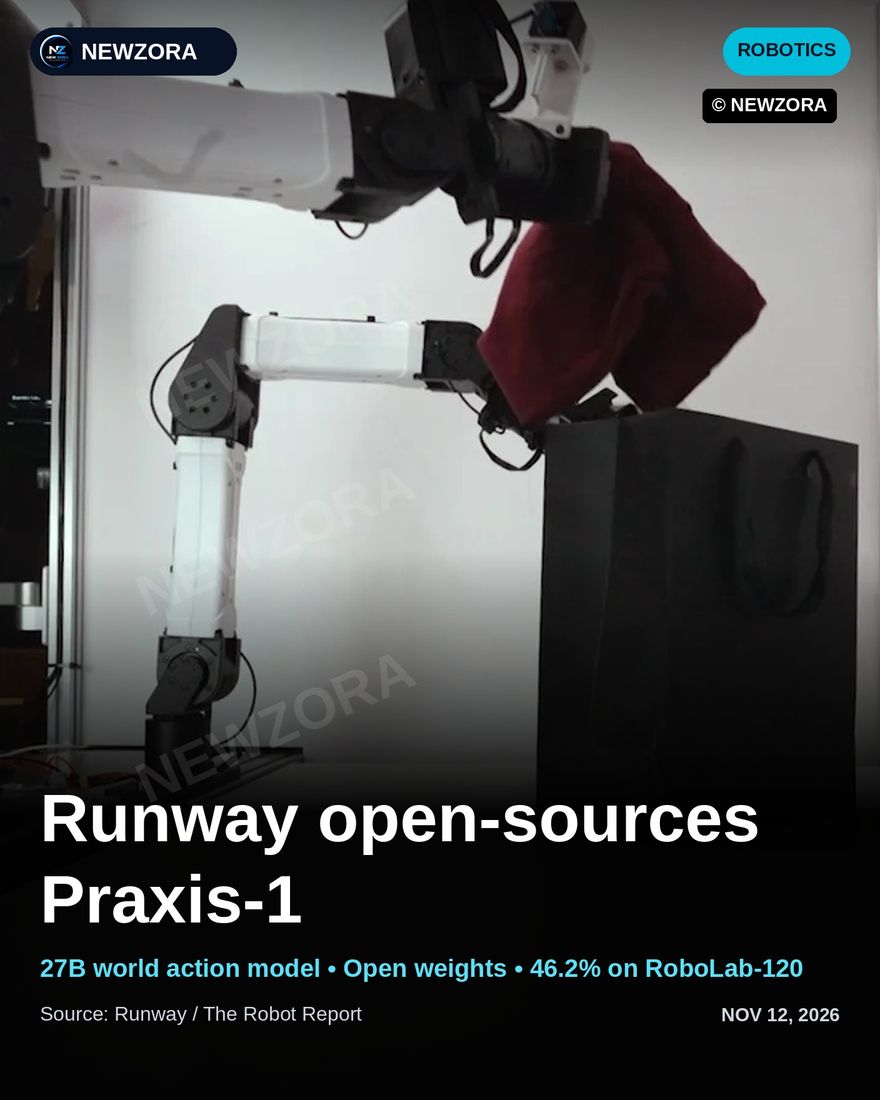
Runway open-sources Praxis-1, a 27B robot brain anyone can run
What Praxis-1 is
Praxis-1 is what Runway calls a world action model. It is a mixture-of-experts diffusion transformer with 27 billion parameters in total. Its video backbone contains 26.9 billion parameters, of which approximately 2.8 billion are active for each token, and it is paired with a 314-million-parameter action expert. The two components operate together: on each call, the model imagines the next 1.6 seconds of video and derives 24 action rows at 15 hertz from that prediction. In effect, the model plans motion by first predicting what the scene will look like and then reading robot commands from that prediction.
The model is intended for general-purpose robotic manipulation rather than a single task or a single robot. Runway published three checkpoints with the release: a base model, a single-arm model fine-tuned on the DROID dataset, and a bimanual model fine-tuned on the YAM dataset. The two fine-tuned checkpoints are intended to give developers working models for common arm configurations, while the base model provides a starting point for fine-tuning on new hardware and tasks.
Benchmark results
According to Runway, Praxis-1 leads the RoboLab-120 leaderboard with a success rate of 46.2 percent, corresponding to 555 successful episodes out of 1,200. The nearest competitors on the same leaderboard are FLUX 3 Action at 42.9 percent, Cosmos3 Nano at 36.8 percent, and pi0.5 at 28.0 percent. These figures are Runway's own reported results and have not been independently reproduced. RoboLab-120 is a simulated benchmark consisting of 120 tabletop tasks, each run ten times. A 46.2 percent success rate therefore means the model fails in more than half of simulated attempts, and simulation performance is not a measure of reliability on physical hardware.
The benchmark result is nevertheless notable because it places an openly available model ahead of systems from larger, well-funded rivals on the same test. The comparison is limited to the RoboLab-120 task set, and Runway has not published equivalent results for other widely used manipulation benchmarks.
Hardware and availability
Runway states that Praxis-1 runs across a range of hardware, from H100 and B200 data-centre GPUs to RTX 5090 and RTX PRO 6000 workstations and to Jetson Thor modules mounted on the robot itself. The full model in bfloat16 precision occupies 54.4 gigabytes and requires a single GPU with 80 gigabytes of memory. The workstation and on-robot paths therefore depend on a quantised version rather than the full-precision model.
An experimental 4-bit NVFP4 quantised checkpoint occupies 17.5 gigabytes and is the version intended for RTX 5090-class hardware. Runway itself states that the speed and closed-loop accuracy of this quantised version still need measurement, so its real-time performance on consumer hardware remains unverified at the time of writing. Developers should treat the workstation claim as provisional until Runway or independent testers publish measured results.
Three launch partners are already running the model in their own systems: Noble Machines, Standard Bots and Ultra. Their involvement gives the release an immediate base of real-world deployments, although no performance figures from those deployments have been published.
Known limitations
Runway's own report lists failure modes that developers should expect. The model struggles with look-alike objects, where two similar items are present in the scene; with vague instructions, where the task description does not specify enough detail; and with long single-prompt tasks, where a complex instruction is given as one prompt rather than broken into steps. These are characteristic weaknesses of vision-language-action models and are not unique to Praxis-1.
The open-weights licence is permissive: Apache 2.0 allows commercial use, modification and redistribution. The model is therefore available to any organisation that can meet the hardware requirements, including commercial robotics companies and academic laboratories.
Why it matters
The release arrives in a year of rapid movement in robot foundation models. Google has advanced Gemini Robotics 2.5 and NVIDIA has advanced GR00T 2, both of which pursue the same goal of a general model for physical manipulation. Praxis-1 differs from those systems in that its weights are openly available under a permissive licence, while its competitors remain closed or partially restricted. Open weights lower the cost of entry for smaller robotics teams and make it possible to audit, fine-tune and extend the model without a commercial agreement.
The practical consequence is that a robotics team with an 80-gigabyte GPU can now run a model that, on one simulated benchmark, outperforms the leading alternatives. That is a meaningful shift in who can work at the frontier of robot learning. The caveat is equally clear: the benchmark is simulated, the success rate is below half, and the hardware requirements remain high. Open access does not remove those constraints; it makes them visible to a wider community that can now test and improve the model directly.
What comes next
The next evidence to watch is measured performance of the quantised checkpoint on workstation hardware and results from the three launch partners' deployments. Independent reproduction of the RoboLab-120 figures, and results on physical robots rather than simulation, will determine whether the benchmark lead transfers to real-world manipulation. Runway has not disclosed a timetable for further checkpoints or for a quantised version with measured closed-loop accuracy.
More in AI

Musk and Sweeney tell Nvidia's board: save Jensen
Microsoft's Lazarus: 7 edited neurons turn an AI agent into a sleeper backdoor