Nvidia financed its own chip demand
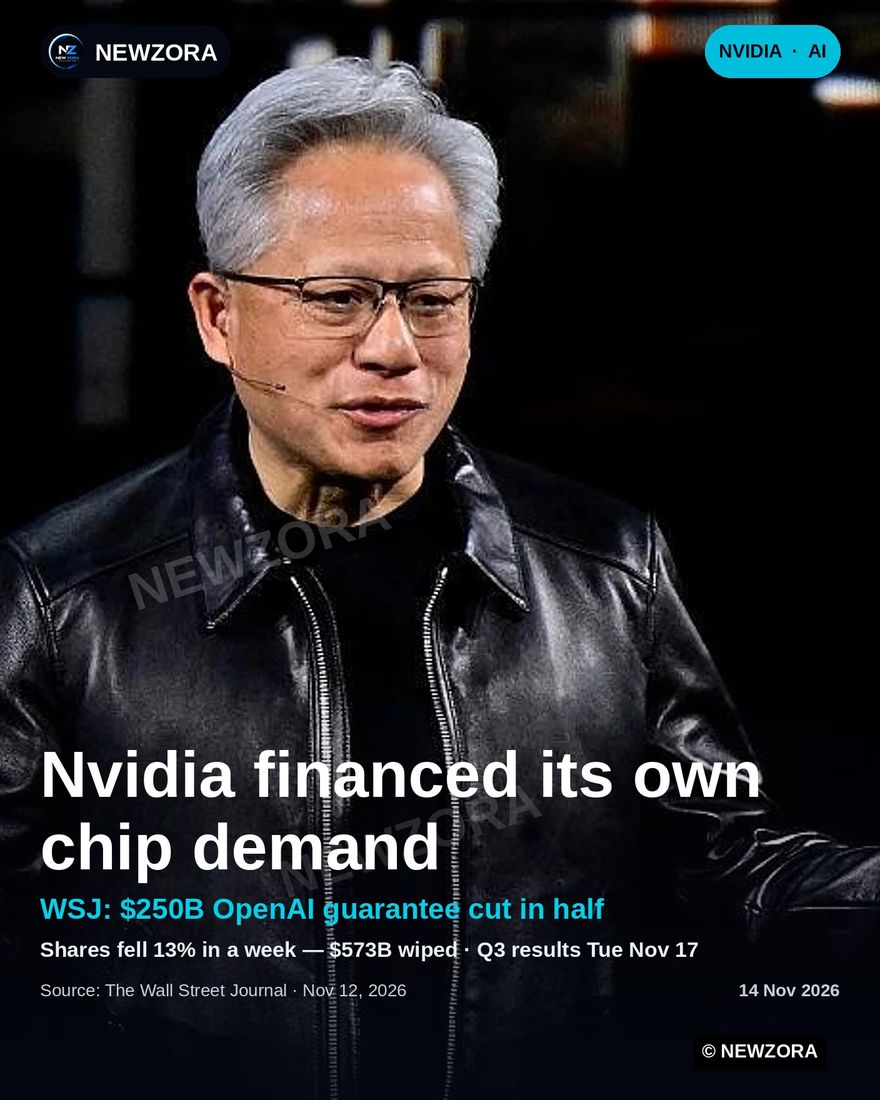
The report raises a question that now sits at the centre of the artificial intelligence investment cycle: to what extent is demand for the most advanced chips being sustained by the chipmaker itself. The remainder rests on the Journal's reporting, and it is presented here as reported rather than as established fact.
The guarantee programme
According to the Wall Street Journal, Nvidia offered financial guarantees to cloud providers and data-centre developers worth billions of dollars, with the aim of enabling those customers to buy its chips. The programme was pushed internally by Nico Caprez, the son-in-law of Jensen Huang. Under the arrangements described in the report, the providers that received the guarantees were to give Nvidia a cut of their revenue in return.
The structure, as reported, differs from a conventional sale. Rather than a customer paying for hardware from its own resources or from third-party financing, the chipmaker itself underwrote part of the customer's ability to pay. The Journal's report does not state that Nvidia has disclosed the full scale of the programme, and the company has not published a consolidated figure for the guarantees it has extended under it.
The Ohio data centre
The largest arrangement described in the report concerned a data centre for OpenAI in Ohio, developed by SB Energy at a site known as PORTS-Pike, with a planned capacity of 4.25 gigawatts. According to the Journal, the parties discussed a guarantee of approximately 250 billion dollars for the project.
The commitment was later reduced. Colette Kress, who served as Nvidia's chief financial officer and is now the company's interim chief executive, cut the commitment roughly in half. A scaled-back version of the deal was signed in August 2026. The signed guarantee is capped in Nvidia's own regulatory filing: a Form 8-K dated 17 August 2026 places the maximum guarantee for the Ohio project at 105 billion dollars. The precise figure for the reduced commitment has not been stated publicly beyond the description that it was cut roughly in half, and no figure between the original discussion and the filed cap should be treated as final.
A disagreement inside the company
The report also describes internal disagreement over the programme. According to the Journal, Kress pushed back against the guarantees in a finance meeting held in August 2026. Huang is reported to have responded by calling her "a deer in the headlights" and by dismissing her as a mere "reporting CFO". The exchange is reported by the Journal and has not been independently confirmed by the company.
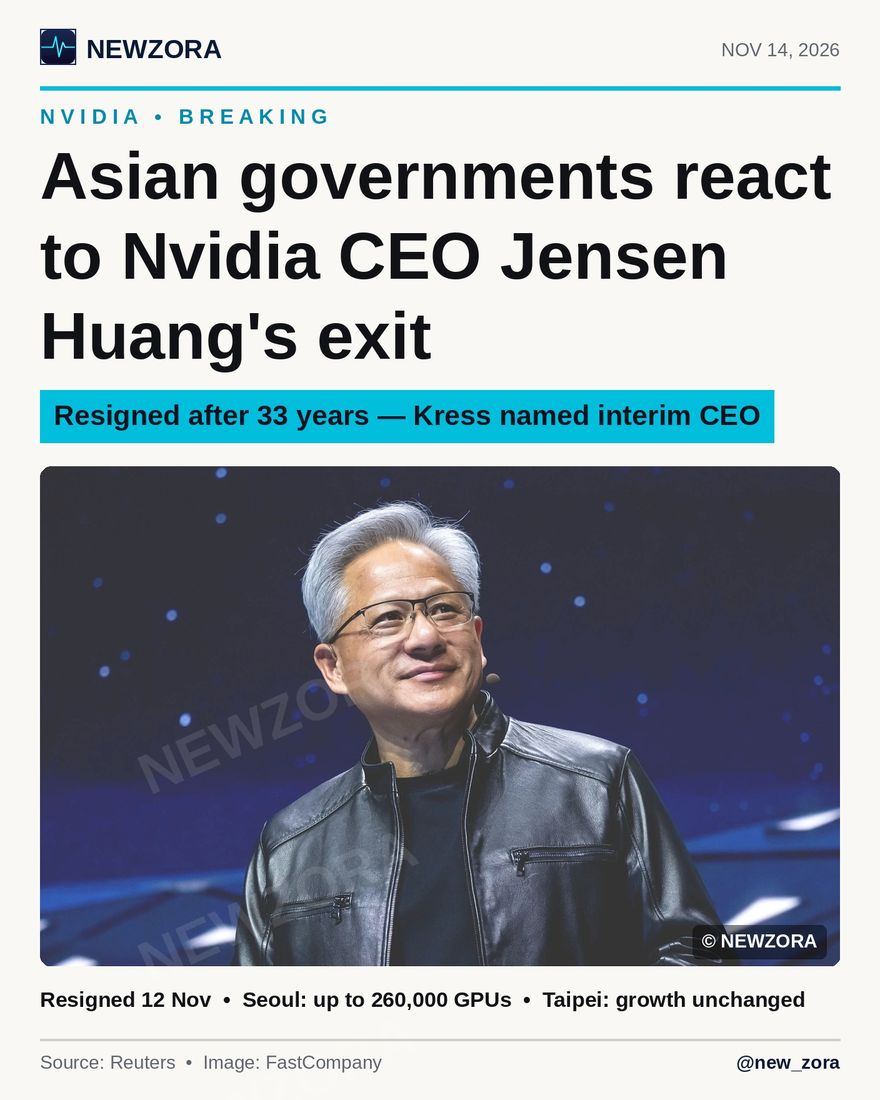
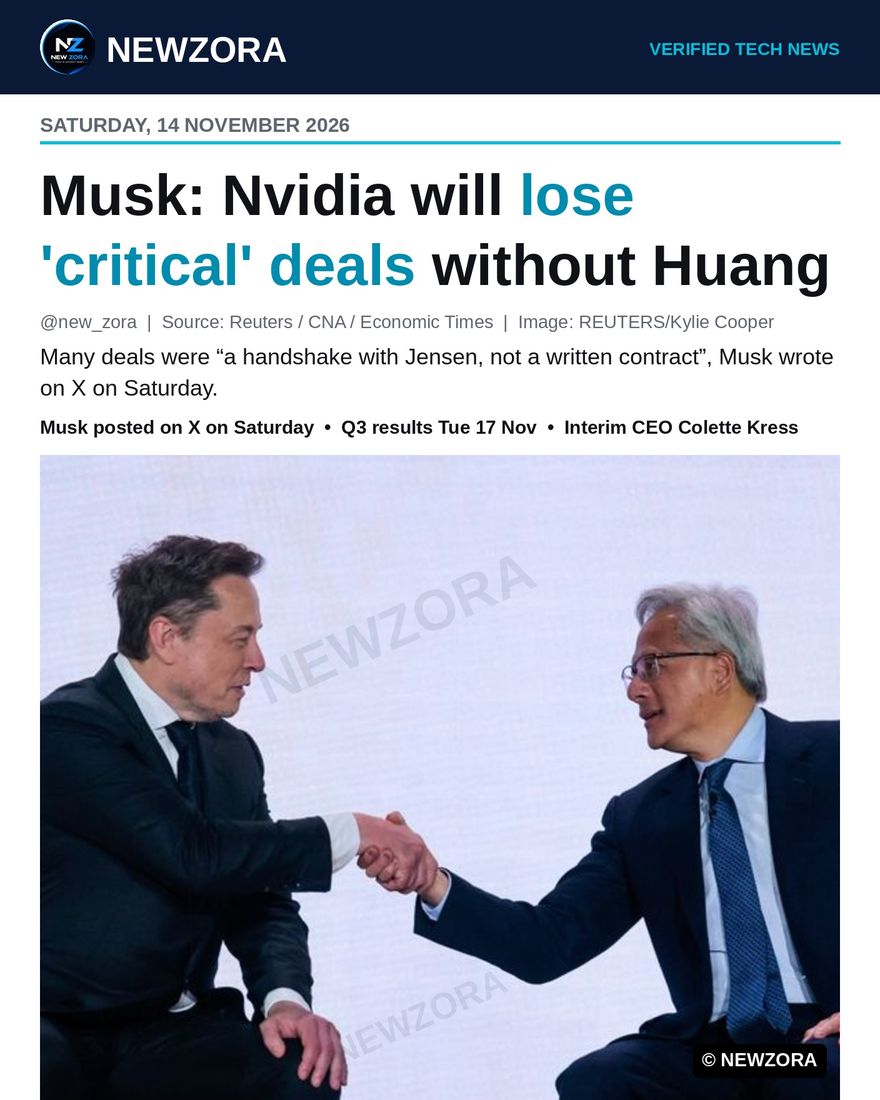
Kress now leads the company as interim chief executive, following Huang's resignation on 12 November 2026. The circumstances of that resignation have been the subject of reporting and speculation, and no single account has been established as fact. What is established is the sequence of events: the resignation followed the period in which the guarantee programme was under discussion, and Kress, who had questioned the programme, now holds the chief executive's office on an interim basis.
The wider balance sheet
The scale of Nvidia's financial commitments can be assessed, in part, from its own filings. The company's Form 10-Q for the quarter ended 26 July 2026, filed on 26 August 2026, contains in Note 10 a set of commitments and guarantees that analysts have summed at approximately 530 billion dollars. That figure is an analyst's calculation, not a total printed in the filing, and it combines items of different kinds.
The largest component, approximately 279 billion dollars, consists of supply and capacity purchase obligations. These are Nvidia's own orders to its suppliers, placed to secure manufacturing capacity and components, and they are not guarantees extended to customers. A second component, approximately 108.5 billion dollars, represents the company's maximum gross guarantee exposure, which includes the 105 billion dollar cap on the Ohio guarantee described above. The remainder of the analyst's sum consists of other items disclosed in the same note. The 530 billion dollar figure should therefore not be described as guarantees alone, and it should not be described as a filing total.
A separate measure of Nvidia's reach into the artificial intelligence ecosystem comes from PitchBook data reported by TechCrunch on 13 November 2026. According to that data, Nvidia took part in 105 startup funding rounds in 2026.
Market reaction
Investors reacted sharply to the week's developments. Nvidia's shares fell by approximately 13 percent over the course of the week, wiping out approximately 573 billion dollars in market value. That decline is the largest weekly loss of market capitalisation ever recorded by a single company, and the worst weekly performance for Nvidia's shares since April 2025. On Friday, the shares closed at 162.85 dollars, down 2 percent on the day.
The scale of the decline reflects more than a single report. It follows a period in which questions about the durability of artificial intelligence spending have grown louder, and in which the departure of the company's founder has added uncertainty about its direction. The market's judgement, as expressed in the share price, is that the combination of these events materially changes the outlook for the company, although the extent of that change remains a matter of debate among analysts.
What comes next
Nvidia is scheduled to report its third-quarter results on Tuesday 17 November 2026, after the close of trading. The report will be the first earnings announcement since Huang's resignation on 12 November, and the first under Kress as interim chief executive. The results, and the guidance that accompanies them, will provide the first formal statement from the company on demand for its chips since the guarantee programme became public.
The questions that investors and analysts are expected to focus on are narrow and specific. They include the size of the company's remaining guarantee exposure, the terms on which any further guarantees might be extended, and whether the demand figures reported in the quarter reflect purchases supported by Nvidia's own financing. The answers, when they arrive, will determine whether the events of this week are remembered as a moment of disclosure or as a turning point for the company.
Sources: The Wall Street Journal (12 November 2026 report, via The Decoder, 13 November 2026); TechCrunch (13 November 2026); The Apex Wire (14 November 2026); The Wall Street Journal live coverage (13 November 2026); Economic Times; NDTV; Outlook India; Seoul Economic Daily.