
IBM unveils Quantum Nighthawk r3 — 1,040-qubit system planned for 2027
The announcement places IBM on a path beyond 1,000 qubits, a scale the company presents as a step toward quantum computers capable of work that is impractical for classical machines. The claim rests on two elements: a larger processor, and a modular method for connecting processors together so that their qubit counts can be combined.
The Nighthawk r3 processor
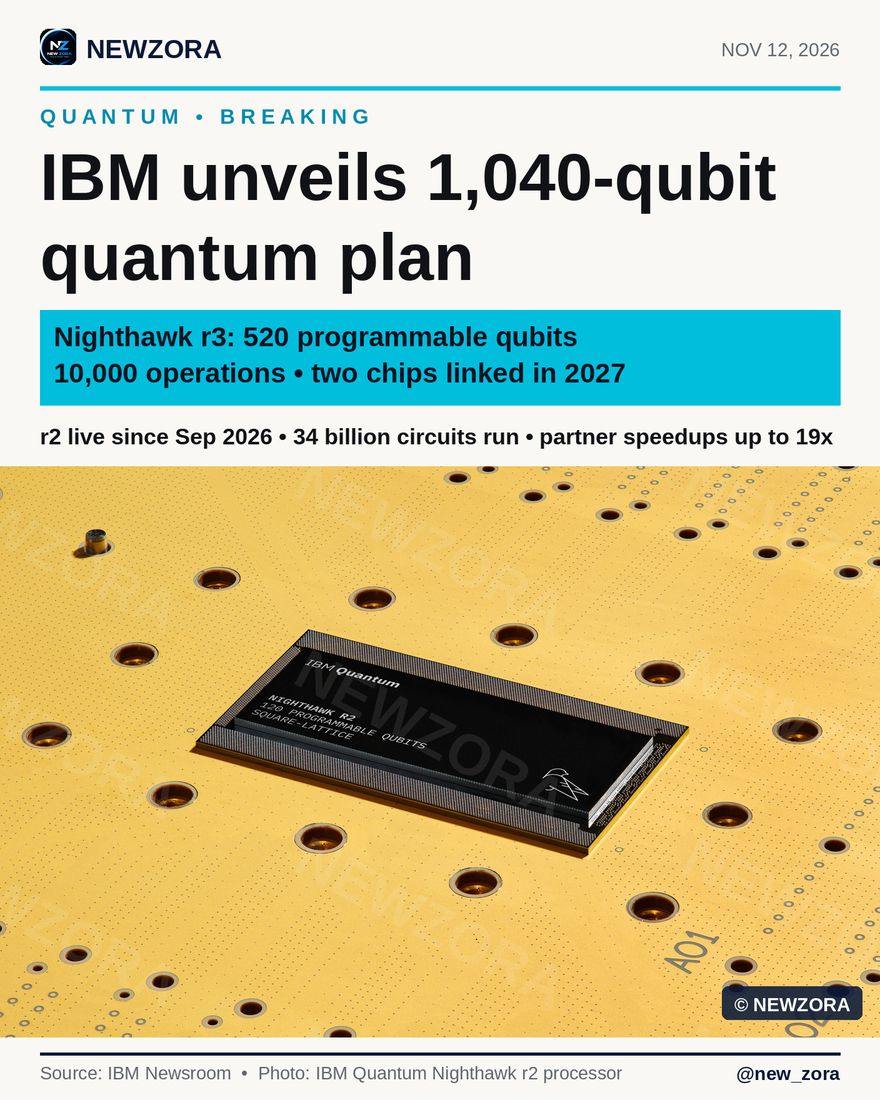
The Nighthawk r3 is designed with 520 programmable qubits out of 2,034 total physical qubits on the chip, according to IBM. The processor is designed to execute 10,000 quantum operations, a figure IBM presents as a measure of the depth of computation the chip is intended to sustain. The chip also carries 10 chip-to-chip connectors, known as l-couplers, which are the components that allow two processors to be joined into one larger system.
The distinction between programmable qubits and total physical qubits matters. The 520 programmable qubits are the qubits available for computation. The remaining physical qubits support error management and control functions. A headline qubit count therefore describes only part of the chip, and the number of operations a processor can execute before errors accumulate is a separate and equally important measure.
Modularity: linking processors together
The central technical claim in the announcement is modularity. Rather than building a single ever-larger chip, IBM plans to connect smaller processors into a larger system. The company reports that it has already linked two Nighthawk r1 processors using four l-couplers, achieving 99.3 percent state-transfer fidelity between the chips. The stated target for this link is 99.9 percent fidelity.
IBM also reports that it has linked two cryogenic modules, the refrigeration units that cool quantum processors to operating temperature, and that the combined system was cooled below 15 millikelvin. Cooling to this level is required because quantum processors operate only at temperatures close to absolute zero. The ability to connect cryogenic modules is a precondition for systems that contain more than one processor, since each additional chip adds heat and control wiring that a single module cannot accommodate.
The 2027 plan follows directly from this work. Two r3 processors, each with 520 programmable qubits, would be linked through their l-couplers to form a single system with 1,040 programmable qubits. IBM has not stated a date within 2027 for this step, and the r3 processor itself has not yet been built.
The current hardware: Nighthawk r2
The processor in service today is the Nighthawk r2, which carries 120 programmable qubits and has been in service since September 2026. According to IBM, the r2 has run 34 billion circuits since it entered service. The company also reports speedups of up to 19 times on partner workloads when compared with its previous generation of processors, the Heron family. The energy company E.ON reported a speedup of 15 times, and a joint IBM and Oak Ridge National Laboratory workload reported a speedup of 12 times.
These figures require careful reading. They are partner-reported results measured against IBM's own previous processors, not independent benchmarks against competing quantum hardware or against classical computers. They show that the r2 performs substantially better than its predecessor on the workloads tested, but they do not establish a general performance advantage over all alternatives.
What IBM said
Jay Gambetta, Director of IBM Research, described the standard by which the company judges its progress. "Useful quantum computing hinges on whether results can be delivered with accuracy and speed, both are fundamental." The statement frames the announcement as a claim about quality as well as scale: a larger qubit count is useful only if the system returns correct results quickly enough to matter.
The emphasis on accuracy connects to the fidelity figures reported for the processor links. A connection between two chips that loses information at each transfer would cancel the benefit of adding qubits. The reported 99.3 percent state-transfer fidelity, against a target of 99.9 percent, shows both the progress made and the distance remaining.
Why it matters
If the plan holds, the 1,040-qubit system would be the largest quantum system IBM has assembled, and one of the largest announced by any company. The modular approach matters because it offers a route past the physical limits of a single chip. Fabricating ever-larger monolithic processors runs into limits of yield, wiring density and cooling. Linking smaller, proven processors together is a way to keep scaling without solving all of those problems at once.
The approach also matters for the economics of quantum computing. A modular design allows a manufacturer to reuse a proven processor design and to repair or replace individual modules, rather than discarding an entire large chip when one part fails. Whether this advantage materialises in practice will depend on the fidelity of the links at scale, which is the figure IBM is still working to improve.
What happens next
The next verifiable step is the construction of the r3 processor itself, followed by the linking of two r3 chips in 2027. Until the r3 is built and tested, the 520-qubit figure and the 10,000-operation figure remain design specifications rather than measured results. The 1,040-qubit system is likewise a stated plan, and its realisation will depend on the r3 meeting its specification and on the l-coupler links reaching the fidelity IBM targets.
Observers should watch for three specific results: first, confirmation that the r3 has been fabricated and is operating; second, measured fidelity figures for links between r3 processors; third, performance figures from partners on workloads run on the larger system, with the comparison hardware stated explicitly. Each of these would convert a part of the announcement from a plan into a measured fact.
Caveats and limits
Three qualifications apply to this announcement. First, the r3 processor is a design target. IBM uses the language "will be built to" for its specifications, which means the figures describe intent, not measured hardware. Second, the 1,040-qubit figure is a 2027 plan for two linked chips, not a single chip and not a system in service today. Third, the speedup figures of up to 19 times are partner-reported results measured against IBM's previous Heron processors, not independent benchmarks, and they apply to specific workloads rather than to quantum computing in general.
More in Science

Musk and Sweeney tell Nvidia's board: save Jensen

GitHub 'wfx-loot' secret stealer hits 61,764 repositories