
Google launches Gemini Decisions API
What the API does
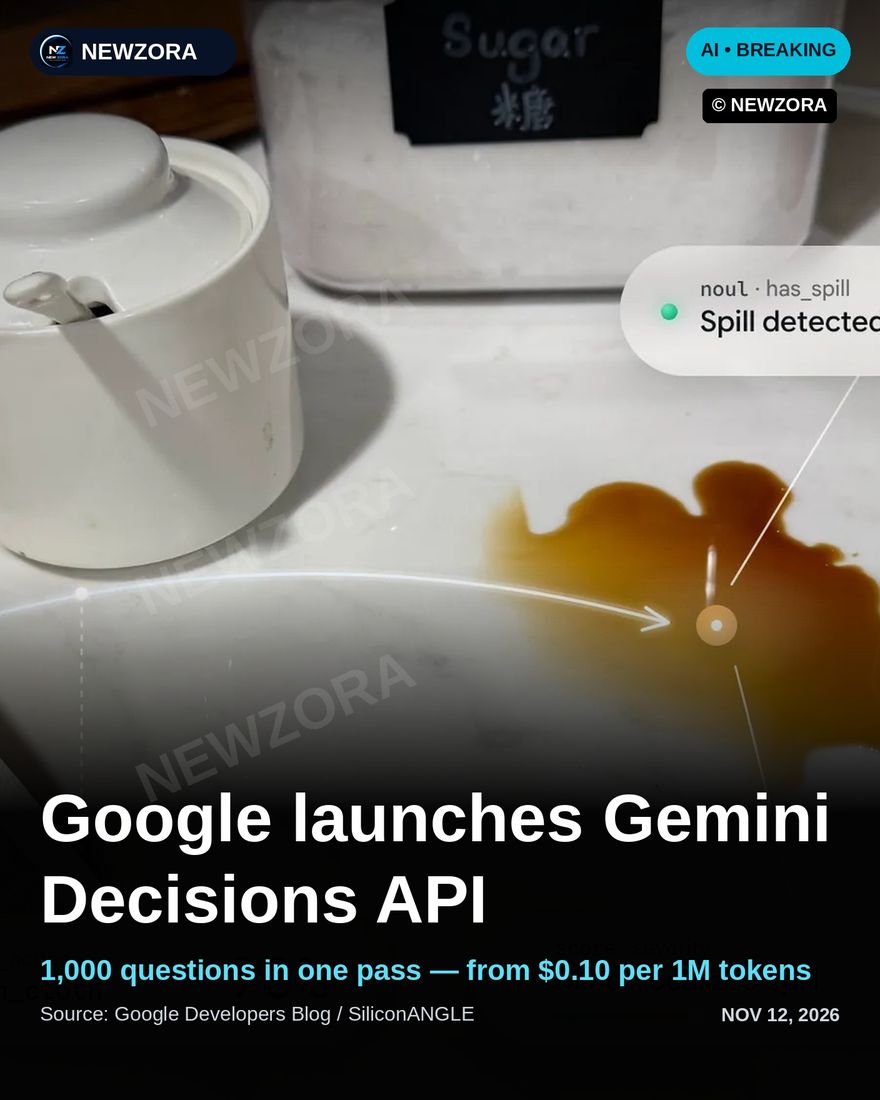
The Gemini Decisions API is designed for a task that traditional language models handle inefficiently: answering many small, structured questions about the same input. A single request can carry text, images, audio, video, or PDF documents, up to 256,000 tokens of shared context, and can pose as many as 1,000 independent questions against that input. The questions fall into three types: yes or no, multiple choice with between 2 and 255 options, and rubric scoring.
Rather than generating each answer token by token, the model scores all questions in a single forward pass and returns probabilities together with confidence scores between 0 and 1 for each answer. The design removes the sequential decoding that makes a conventional model slow and expensive when the same document must be read once for each of many questions. According to Google, the shared input is billed once per request, and there are no charges for thinking tokens, optical character recognition, or transcription.
Performance and pricing
Google reports end-to-end latency of 150 to 250 milliseconds, with median model compute of 50 to 100 milliseconds, measured at contexts of up to 16,000 tokens. Latency remains nearly flat as the number of questions rises from 1 to 100 per request. The company has not published equivalent latency figures for the maximum of 1,000 questions or for the full 256,000-token context, and no such claim should be inferred from the figures above.
Pricing is set at $0.10 per 1 million input tokens, with no charge for output tokens. Google states that the service is nearly five times cheaper than Gemini 3.5 Flash-Lite used with the Interactions API for comparable workloads. A no-cost tier is available in Google AI Studio for prototyping.
On benchmarks, Google reports that Gemini Decision 1 leads across its own evaluation suite with the lowest calibration error, a measure of how closely a model's stated confidence matches its actual accuracy. SiliconANGLE reports that the model outperforms Jev and OpenAI's Decisions API on seven of nine benchmarks in Google's comparison. These are Google's own claims, published by the company and reported by the outlet, rather than independently verified results.
Where the model is already in use
Google describes several internal deployments. Gemini Notebook uses the model as a real-time router, and the company reports up to 40 percent lower latency on everyday queries as a result. Stitch, the company's interface-design tool, uses it for rapid canvas evaluation. The CC emoji picker relies on it to select among more than 200 options, and a Google Search safety layer uses it to assess Model Context Protocol tools.
The use cases Google names for developers are tool selection, policy checks, model routing, and context grading. Each of these is a task in which an application must make many small judgements quickly, and where the cost of a full generative response for every judgement would be prohibitive. A policy check, for example, may require dozens of separate yes-or-no determinations about a single document. A routing decision may require scoring every available tool or model against one request. In both cases, the value of the new endpoint lies in the combination of structured output, calibrated confidence, and low latency.
Background and context
The release follows the pattern established by OpenAI's Decisions API, which launched last month. Both products address the same observation: as agent systems grow more capable, a large share of their work consists of classification and selection rather than open-ended generation. Dedicated scoring models are the natural response, and the two companies are now competing directly on price, latency, and calibration quality in this category.
The timing also reflects the broader direction of Google's Gemini programme. Gemini 3.5 Flash-Lite, the company's efficient general-purpose model, remains the reference point for the pricing comparison, which suggests that Google positions the new endpoint as a complement to its general models rather than a replacement. The Decisions API handles the judgement calls; the general models handle the generation that follows from them.
Why it matters
For developers building agent systems, the practical significance of the release is economic as much as technical. Scoring 1,000 questions against one input in a single pass, with the input billed once, changes the cost structure of applications that previously had to choose between reading a document once and asking one question, or paying to read it many times. The confidence scores add a second dimension: an application can act on high-confidence answers automatically and route low-confidence cases to a larger model or to a human reviewer.
The calibration claim is the most consequential part of the announcement, if it holds up in independent testing. A model that knows when it is uncertain is more useful in production than a model that is marginally more accurate but poorly calibrated, because the confidence score determines how much of the workflow can be automated safely. Google's claim of the lowest calibration error in its suite is therefore the figure that independent evaluation should examine first.
Availability and what comes next
The Gemini Decisions API is available now through the Gemini API in Google AI Studio, on the v1beta endpoint, using the model identifier gemini-decision-1. Support in Google Cloud is coming soon and is not yet live.
The next questions for the product are straightforward. Independent benchmarks will test whether the calibration and cost claims survive outside Google's own evaluation suite. Developers will determine whether the three question types cover the judgement tasks their applications require, or whether the format needs to expand. And the competitive response from OpenAI, which introduced the category only last month, will show how quickly this new class of model becomes a commodity. For now, Google has set the terms of the comparison: up to 1,000 questions, one shared input, and a price of $0.10 per 1 million tokens.
More in AI
Musk and Sweeney tell Nvidia's board: save Jensen
Microsoft's Lazarus: 7 edited neurons turn an AI agent into a sleeper backdoor