Roku quits smart home to refocus on streaming
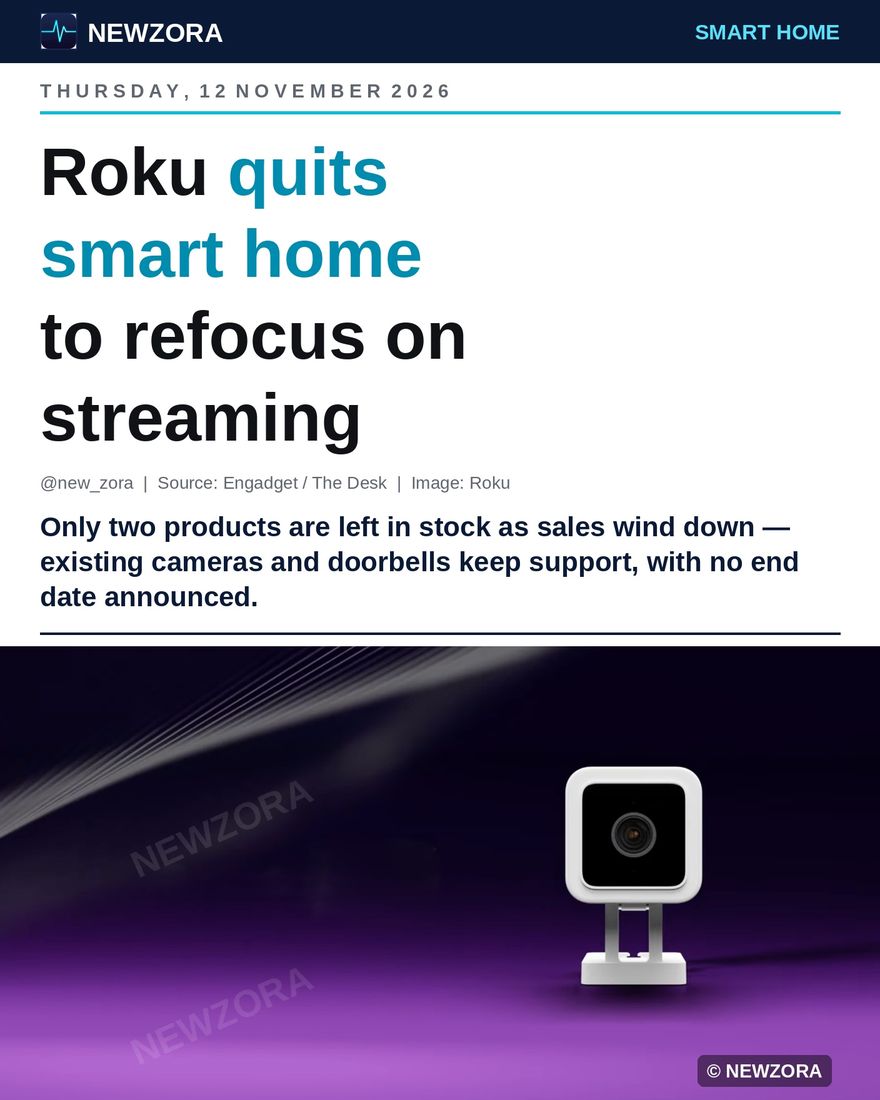
Roku is getting out of the smart home business.
The streaming company confirmed on November 11 that it is winding down sales of its smart home hardware, ending a short-lived push into cameras, doorbells, lights and home monitoring that began only in 2022. The move is a sharp refocus on the business that made Roku a household name: streaming.
"We're sharpening our focus on Roku's core mission: being the top streaming platform… we plan to wind down sales of smart home hardware and will provide continued support and services for Roku Smart Home products," a Roku spokesperson told Lowpass, the tech newsletter run by Janko Roettgers that first reported the news.
What is going away
Roku's smart home line covered video doorbells, indoor and outdoor cameras, smart lights, smart plugs and a home monitoring system. All of it is now being wound down.
The retreat is already visible on Roku's own web store. Only two smart home products remain listed, the Indoor Camera 360° and the Video Doorbell & Chime, and both are being sold at clearance, heavily discounted prices. On Amazon, the picture is similar: only refurbished Roku smart home models are still available.
What is not going away, at least for now, is support. Roku says it will keep supporting and servicing the smart home products it has already sold. The company has not announced any end-of-support date, so existing owners are not being cut off, but no new hardware is coming.
A short-lived experiment
Roku's smart home push was never a long-term pillar of the company. It launched in October 2022, in partnership with Wyze, whose cameras and sensors Roku rebadged and sold under its own name, exclusively through Walmart at first.
The idea was straightforward: Roku already sat in millions of living rooms, and the TV was a natural hub for checking a doorbell camera or turning off a light. But the smart home market is crowded, margins are thin, and Roku's hardware was largely a rebadged version of products customers could already buy cheaper from Wyze itself.
Four years later, Roku has decided the experiment is over.
The Fox question
The timing invites an obvious question. Fox completed its $22 billion acquisition of Roku on November 6, just five days before the smart home exit was confirmed. Was the new owner behind the cut?
According to the reporting, no. The decision to exit smart home hardware was planned before the takeover closed, and the timing is coincidental. Fox bought Roku for its streaming platform and its advertising business, not for a sideline in doorbell cameras, but the call to wind the line down was Roku's own, made before the deal completed.
The financial case
The financial case for the exit is easy to see. Roku's hardware losses more than doubled in the third quarter, widening from $22.9 million to $48.6 million. The company blamed the jump largely on rising memory-component costs, which have squeezed hardware margins across the industry.
For a company whose streaming platform and advertising business are its growth engines, a hardware line burning nearly $50 million in a quarter, and getting worse, was hard to justify. Exiting smart home lets Roku stop feeding a loss-making sideline and put the money back into streaming.
A lawsuit in the background
The exit also comes with legal baggage. A class action filed in March 2026, Moses v. Roku Inc., Case No. 3:26-cv-01422 in California federal court, alleges that Roku removed the free Motion Snapshots feature from its smart home cameras in July 2025.
That is an allegation in a lawsuit, not an established fact, and it has not been proven in court. But it is part of the backdrop to the shutdown: a reminder that the smart home line generated not just losses but complaints.
Why it matters
Roku's decision is a small story about one product line, and a bigger one about focus. The streaming wars have entered a phase where scale and advertising matter more than ever, and Roku, now part of Fox, is choosing to concentrate on the platform rather than spread itself across hardware categories where it had no real edge.
For existing Roku smart home owners, the immediate message is reassuring: your devices keep working, and Roku says support continues. The open question is for how long, since no end-of-support date has been given.
For the wider market, the lesson is familiar. A TV platform can sell a camera, but selling a camera is a different business from running a streaming platform, and when the losses doubled, Roku chose the business it actually knows.
What comes next
Watch for clearance pricing to deepen as Roku clears remaining stock, and for the two surviving products, the Indoor Camera 360° and the Video Doorbell & Chime, to disappear from the store once inventory runs out. The bigger question is what Roku does with the freed-up focus: whether the Fox era brings new streaming moves, new advertising products, or a renewed push on the platform itself.
One thing is clear: the Roku smart home experiment is over.
More in Tech
NVIDIA board preparing to oust CEO Jensen Huang

Anthropic's IPO could top $1.5 trillion